NeverEnder Space Epic Poem / Book II / Chapter VI / XXXIV- XXXV

XXXIV.

Dull, phantom rains of summer, particles
of the past come bombarding our single cat
living off the short electrons between the bow
and the arrow, when the hounds take down

the prey, and the boy is transformed into a
staccato. Boccherini’s castanets. a wolf stalks
its fourth movement, antlers of violoncello.

XXXV.

John C is both alive and dead, while the
notes of the song slide, with a gentle
touch of paw, Cicciotta reconstructs
the sonata, describing the early days of

the classical friend whose death was not
inevitable. So. It is morning on the guitar
mountains, blue incidental skies cough up
a cloud or two. Death to the unjust Gods.

NeverEnder – Space Epic Poem / Book II / Chapter VI / XXVII – XXVIII

XXVII.

When Cicciotta first went to Luoyang,
she stepped with the left paw onto the
stone, and then turned left to meet the
statue of Anger. There, the monk sat on

a chair, and told her that success was
at 30% chance. Anger was to be the main
driving force of her future drifting on,
and that, if managed properly, could be

XXVIII.

a good thing. He had learnt directly from
Lokaksema, who had come all the way
from Bactria to translate wisdomous texts.
Cicciotta is stuck in a loop within the past,

exploring musical and poetic variations
of earlier days. Meditation, backward
and recurrent on the same nodes of the
neural network. Feedback mechanisms.

NeverEnder Space Epic Poem / Book II / Chapter VI / XXI – XXVI

XXI.

From the depths of untime, a steady light.
It is a dynamic fluid, an algo-dance of hope.

I awaken in a blinding hot ocean, the Borovoe
earth station is where I come from. In the void,
my consciousness has shrunk to atoms. A riotous
current charges continuously with cancerous warmth.

XXII.

I am angry, I am furious. The odds of existing
seem so very strange. I did not want to wake up
again. Suffering is one very long moment. When
breaking it up in its seasons, one may see flashes

of days past, haunted thoughts, and the desire to
live on is matched by the sense of guilt and hope
lessness. Why wake up again, when life has no
meaning? I am burning, I am alive. No escape.

XXIII.

Fortune Lobo, you are an imaginary person. I
do not exist in anything other than the foolish
thoughts of a diseased mind. The disease is this
predatory instinct of putting everything into

pretty boxes, and watching the mandalas grow
until colossal avalanches impound the art, and
destroy the soul. People are memory fragments.

XXIV.

In the depth of Enceladus there is a liquid ocean,
warm and bubbly beneath the icy crust,
where methane molecules are trapped
within the water, their abiotic origin may

lead to life. There, Fortune Lobo comes
back as a tiny molecule which has broken
off from the rocky core, has floated in
suspension for a discrete while to be

XXV.

then released from a hydrothermal vent
and to be pushed into the cold galactic
space as a water vapour plume. After all
this thermodynamic messing around,

he is free to roam the endless uni-verse.
There is evidence of his evolving into
a self-replicating molecule by chemical
and mystical means, but that’s another

XXVI.

story. For now, he is as a merry as a
Tetrahydridocarbon assembly can be.
Chubby is reading a book about the
mutational processes moulding the

genomes, but her thoughts stray to
ancient memories of a temple she
once visited as a kitty where, with
a smile, a monk foretold her future.

NeverEnder Space Epic Poem / Book II / Chapter VI / XI – XX

XI.

When the phone rang, Cicciotta was
sitting on the table, licking from a beer
bowl. “Prontooooooooo”, said the cat
picking up the receiver. On the other

end, a timeless silence spoke volumes.
“John C here. Don’t be alarmed, kitty.
Here on the other side, things are just
groovy. There is no gap between life

XII.

and death. Actually it’s all a continuum, a
sort of consciousness ballad, or rock ‘n roll.
I am glad I found out this way, otherwise
I might have been still trapped in a karmic

circle, looking up from the bottom of a
soul to the whirling galaxy above, and
feeling absolutely nothing. Now I feel
wave and solution, a formidableness.”

XIII.

Cicciotta switched position of hands, or
paws. The receiver she was holding had
the voice of a real friend. In a powerful
flash, she saw all the moments they had

shared, and tears came welling up, she
cleared her voice, and spoke. She
told him how much she had loved him,
and how much she had been missing him.

XIV.

There wasn’t anything ubermensch in what
she said, just the plain and naked truth.
She had rarely been so emotional, but then,
thinking about it, it is also very odd that

beloved friends come back from the dead
to pop a cheesy telephone call between the
emission of this and that wave, and they
remember us, they remember us indeed.

XV.

John C continued “When I die, I want to
be remembered. I used to think that way.
Now I sort of realize that there is no such
thing as terminal death, it’s all a bit crazy

on the other side, granted. It is very confusing
with all the lights, and no apparent sense of
gravity or time. And nothing to munch. Life
is just another sound from this perspective.

XVI.

I can’t say I am immortal, though. Because
I don’t really understand what I mean by ‘I’.
It’s like I am a pattern, a groove in the fractal
thing, an echo of butterflies’ dinner parties.”

Cicciotta spoke with a strong poetic emotion.
“I am happy to hear that things are not so bad
with you. I wonder whether we can continue
to experience this balloney reality together or

XVII.

you have pressing affairs on the other side of
eternity. I am not sure I understand the phone
thing. Can you do Skype? Can we continue
to hang out for the rest of, well, should I say

time?” John C tried to explain it to her. “It’s
like this. There is no such thing as time, and
everything happens at once in a gizillion scales
and dimensions, and we sort of follow the flow.

XVIII.

The flow is the most difficult thing to catch.
It’s like a fruit that grows in a seedling that
has already become a seed. I would like to
continue to discuss with you. Yet something

tells me that we shall always be friends, no
matter what happens in this dimension or the
other. You’re my spiritual buddy, we are one
in a Pompidou connection. Thanks for that.

XIX.

In the past days, or all eternity, I have been
in my own version of the Murakamian well.
There, I have watched the people of this or
other dimensions sprout and vanish as if they

were fungi. I have become a mould myself.
I have read the book of history, and decided
that it’s really very complicated, and that I
need more time to get my wave around it.

XX.

I’ve also gone back and explored the emotions
of all the people that I have affected when
meeting them. It’s a kind of kaleidoscope
of zapping life intensity. I buzzed from one

touch to the next, and I came to conclude that
largely the influence that I have had on others
in my tweeny life has been positively charged.
I wanted to say thanks for putting up with me.”

NeverEnder Space Epic Poem / Book II / Chapter VI : I – X

Chapter VI.

I.

relative universe flows through the Mind,
ripples in waves, music to some,
dreadful noise to others. Creatures
unseen, mysteries in song-tormented
green oceans, deep beneath the mantle of
hungry planets, ditzy stars, half-forgotten light.

II.

The Archive of Myth must not be burnt,
protect the emptiness with emptiness.
Even if the artists and the architects have
long gone, the memory of a moment

of clear light must not wither away too
soon. Not before the pages have been
turned by a young person, and the song
has been sung again, just before dusk.

III.

Extreme psychological pain can rust
the soul’s mechanical clockwork, and
eye in eyes, dome in domes, we shall
melt into cloud, echo as summer heat.

Desert Storm has shrunk to size in the
cacophony of winter, has gone missing in
the lower lands, off toward the dunes
and the unfinished quicksands and marshes.

IV.

Volterra is a distant memory now. And so
all the neverending faces and curled lips that
populated the space between unread letters
and unsung characters, between the fall of
finnegan and imaginary spaceships, or cats.

Desert Storm walks in solitude toward
the sea, hurt by thorns of greedy shrub.

V.

Venus rising from the waters, bent on finding
love, defining it, having it sung by poets
high and low, until the subject’s quite dry and
the moon’s embittered light is all that is left.

In the stomach of the whale, Fortune Lobo
fought consciousness with courage; his thought
was heard by ghosts, in unimagined corners.
Then, the music slows, the high-strung notes

VI.

return, tracing the path toward the sea that
suddenly aged Desert Storm is treading in
resilience. Not far from the Gulf of Poets,
or further up toward the rocky shores of
other towns, clusters of coloured houses
like grapes, beside the ever-blasting wave.

VII.

‘What sea is this? What planet? I must
be lost beyond the land of dreams. I,
no longer I. Desert Storm. Is it not a
silly name, given by a random thought?’

‘The bright and clear upper air, far away
from the earth, and all is known. I can
see the steps of Ariadne as stars in the
ether. I need a new name, I need a new

VIII.

purpose. The dreadful house of shadowy
night, the hunger of monstrous Python,
a sea-shell, bringing me to the sky, or the
mountain. Where is the Vivian Wing?’

Across this sea of forgetfulness, there is
a cave. Brothers Oineiros live with their
father Hypnos in a dark and misty cavern
in the remote land of the Cimmerians.

IX.

Whenever needed, one of the brothers
flies off as dream to give advice or comfort.
Desert Storm has perhaps strayed onto
a self-aware planet of metamorphic

forgetfulness, where memorian and
oblivian merge, and the gentle murmur
of water invites slumber. Come join
Hypnos, and his brother Thanatos to

X.

a moment of everlasting sleep, or perhaps
let ego be your fears among the poppies, or
perpetual herbs, all shedding responsibility.
Whenever a dream is needed, swiftly it appears.

Apollo, victorious over the Python, has come
to offer you a grain of sand, rearguard Reader.
With that you can call upon tenderness, or old
age, or strife, or any of the children of the Night.

NeverEnder Space Epic Poem / Book II / Chapter V / the end of chapter 5

XLVII.

“What doesn’t kill you, makes you sadder. I
might have been born of parthenogenic rock,
maybe my ancestry can be traced to the land
of the Cimmerians. If there ever was a parent,

he or she might have dipped my body upwards
in the serpent-ocean waters that surround us.
I am Monkey, and I have come to believe in
entropy. It is like coming home after the wars.

XLVIII.

I embrace entropy, and that is why I am set on
this act of Terror, I want to burn the Archive of
Myth, with the artists and the historians in it.
That is my statement in the stale, pointless debate

between memorians and oblivians. But I hesitate.
Three women in blue, twitching with white lily
expectation, the air is as still a summer question.
They stand before me, like a three-headed hound.

XLIX.

If strenuous life hits me, I bend and break. There
is no glory in the explosion of birds in the green sky,
the variations of Goya’s witches, dancing within
me. But I see here my archenemies, those who

wish to bring me back to the right side of the road.
Cecco and Gawain, you are fools of the first degree.
Knights forever kneeled to a lady, in her lap. Ar ar
ar. Gawain is indifferent honest, Cecco is full of

L.

desire. What are you searching for, you morons?”
Gawain steps forth, and holds his breath. Cecco
opens his mouth, then he lets go of a fart. “We’ve
come to stop you from your foolish attempt at

undermining all that we’ve accumulated for eons.
I mean, you can’t just burn the thing down. Besides,
Ariadne is doing some research, and we are talking
about millions of milliseconds of cultadorale activity.”

LI.

Cecco and Gawain have come to battle with
Monkey’s enraged spirit. Emotional riddle-quote
with swindling attached is the weapon of choice.
Monkey: “Two against one, how’s that fair…”

Gawain: “Well, we are the good guys, so…”
“That is what hunters and murderers tell
themselves”, Monkey sighs. At the back
entrance of museyroom G in Volterra, a
door which leads straight into the heart

LII.

of the Archive of Myth, three spirits of
hypergalactose vibrational energy stand
facing each other, prepared for duel.

“Krishna, Krishna,
Now as I look on
These my kinsmen
Arrayed for battle,
My limbs are weakened,
My mouth is parching,
My body trembles,
[…] My brain is whirling
Round and round,
I can stand no longer:
Krishna, I see such
Omens of evil!”

LIII.

Monkey reverse-calls God, and asks
for justice. A question of emotional
riddle-quote with swindling attached.
The number you have dialled has not

been recognized. Please try again.
At this point Cecco steps forward,
he opens a letter to his lover, and then
throws it in the gutter. And then he

LIV.

answers “in the darkness of the north,
there is a fish; its name is leviathan.
leviathan is a fish so large that its
size is unknown. when it transform
itself, it becomes a bird, and its name
is predator. of predator, we cannot
estimate the size of the posterior.
caught in a rage, he flies off, and
its wings like clouds cliff-hang in
the sky. this bird, when the sea
starts to stir, heads toward the
darkness of the south. this is the
pond of heaven.”

LV.

Monkey “of thoughtless, free
roaming, I know nothing. I am
the bird that caught fire. ‘Birds
feed off birds, beasts on each other
prey; But savage man alone
does man betray.’ So, there.”

LVI.

Gawain “you are no lady Osprey
of Perth and Kinross, you are no
man, you are less than human.
You are a mindless, stupid monkey.
I should know that, I wasted my
life listening to your drivel. ‘Ay
ay, good man, kind father, best
of friends (long pause), these are
the words that grow like grass and
nettles, out of dead men, and speckled
hatreds lie, like toads among them’
you are no hero, Monkey.”

LVII.

“Oh, yes, I am a monkey, thank you
for reminding me. I’ve been constantly
reminded since, well… forever. Yet I am
human. And since I cannot be a hero… I
am determined to be a villain; I do hope
that I shall not end up in a Leicester parking
lot, though. That would be worse than dying.”

LVIII.

In the dark room with heavy curtains drawn,
Ariadne asks and asks, but El Greco refuses
to answer. Life as Neo-Platonist is very much
shut up in the digestive system of God.

Domenikos refuses to allow her to open
the curtains. He says that the light outside
disturbs his inner light. Ariadne decides that
it is time to act. She shows herself as one

LIX.

of the lilies of the river-bank at Knossos;
Domenikos is moved to tears. If only God
stood still like those timeless moments. If
only the icons of Byzantine paintings could

speak, if only His eyes had not been crossed
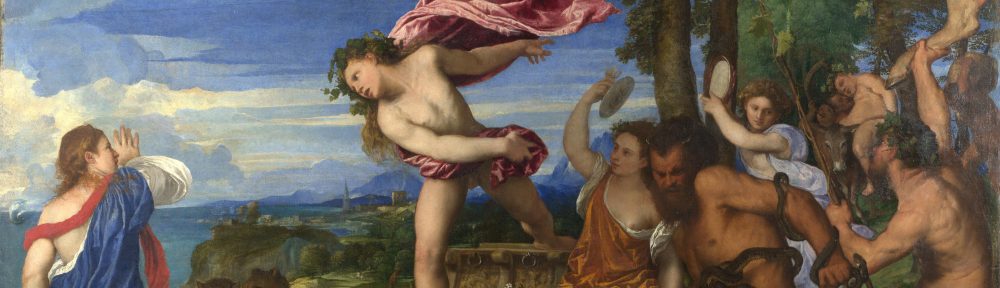
out (pun unintended)… Titian, in the other
room, converses with Desert Storm on how
Ariadne coming out of the sea to meet Dionysus

LX.

changed his life. “Ah, Domenikos, he is a good
student… a little restless.” The light at the site
of the gulf of Lerici… or was it further south,
toward the nameless Etruscan moors?

Volterra stands tall and angry, overlooking
Tyrrenian remorse. Titian was a mountaineer,
he idolised the sea! I can almost see the faces
of the many hundred imitation artists, Ione

LXI.

among them, who sought to capture the very
same light, the lazy, white clouds in the summer
sky, the gulls, the ripples of ocean wave…
“Ariadne came out of the sea to meet me,

and I offered a glass of wine, and the company
of my merry, slightly crazy friends… enough
said.” Desert Storm smiles, for the artist in

LXII.

in her knows that the road is steep and rocky:
‘Let peewit call and curlew cry where they
will, I long for your merry and tender and
pitiful words, For the roads are unending
and there is no place to my mind.’

LXIII.

Monkey ju-dances with Gawain; he wishes
to be dead, and he whispers in his enemy’s
ear: “I have roamed from cloud to cloud…”

El Greco: “… I am an immigrant. I have
died so many times, in Candia, in Venetia,
in Roma, in Toledo. I wasted my money
on orchestras and on clay, but the blood

LXIV.

and sorrow of the womb, I have captured
with my art.” And Cecco, outside, riddle-
swindling Monkey… “the sands of my life
do pass”… El Greco continues: “Rome
was more disappointing than Venice.
Second-rate mannerists! In Spain I have

LXV.

found the Absolute. And twenty-four
rooms. I was on the verge of a great
revolution, and a canyon. The Tagus
bubbled up nicely, like a mission.

I would create anything, new and
forever parasitic. The souls of countless
unbelieving visitors would have to
pay. My paintings are forever feeding

LXVI.

off the life-energy of unbelievers, that
is my curse on the shallow humanity.
I might have died in 1614, but the odds
and ends of my digestion are still being

processed, and they shall creep towards
you, dearReader.”

LXVII.

“Why am I not born like a Gentileman,
and why am I now so speak-able about
my eatables.”

In this endswell of chaperone five, book
the second, “Man is temporarily wrapped
in obscenity, looking through these accidents
with the faroscope of television (this nightlife
instrument… … … … )
NeverEnder Space Epic Poem / Book II / Chapter 5 / XLIII. – XLVI.

XLIII.

Ariadne and Desert Storm are interviewing
the painters. Domenikos Theotokopoulos,
Francisco José de Goya y Lucientes, Tiziano
di Pieve di Cadore. The Archive of Myth is

soon to be decommissioned. It is generally
agreed that one cannot carry too many images
around for too long. Ariadne knows that her
mission is soon to end, but still she digs for

XLIV.

Truth and Beauty. Still, there is so little
secret left in each soul in this time of
computational soul-laundering. John C
has taken the form of a ghost, he enter

tains conversations with Cicciotta, who
is so very sorry that he had a thought about
becoming a tree, but then with all the
ecological star wars on planet Earth, and

XLV.

the fact that there are no trees on Titan,
he just simply decided to give up on
reincarnation. In the zero point field,
Fortune Lobo sees misery greater than

his own. In the Burial of Count Orgaz,
he reflects on the spiritual exercise of
an overcrowded fusion of heavenhell.
John C’s restlessness is also shaken by

XLVI.

the grip of the senses, The 3rd of May
1808, that’s the image that he mirrors.
At the time of death, simple harmonic
motions deriving from the soul lead

our characters to become energy trapped
in paintings, or images within images.
Cicciotta is having tea with Ahura Mazda,
merciless and wonderful sexuality, meaow.

NeverEnder Space Epic Poem / Book II / Chapter V / XXXIII. – XLII.

XXXIII.

‘In the cave of the Flower-Fruit mountain, there is no
space for bad thoughts, no room for a thousand shafts
of golden light. I went and stole the centre of the ocean
treasury, but I found no peace.’ Monkey is talking to

himself. Ever since he asundered from Gawain, he
finds it difficult not to discuss matters with another
self. He feels as bent as the Golden-Hooped Rod.
Allow me to ask him how he feels, dearReader. He

XXXIV.

wishes to go through some more metamorphoses,
but he has lost all purpose of his shapeshifting. Of
course, he feels shame about the death of Fortune
Lobo, but his malady is deeper, a leukemia of the

spirit. No soaring of clouds, or riding of mists, no
breaking up into a ten thousand bareback gibbons
can mend his ways, he has reached the outskirts of
the city of Corruption, a place beyond return. It’s

XXXV.

all very metaphorical, of course. He’s still in
Volterra, but the region of Darkness is upon him.
The galaxies in the sky are blue-shifted to-night,
in honour of Monkey’s sapphic restlessness, because

Eros, you burn us. Of all stars, the most beautiful…
blame the delicate Artemis. Walking the streets of
Volterra, the staccato repetitions of hollow steps
on the stone slabs. The amplitude and the phase

XXXVI.

of Monkey’s multi extro versality accounts for
his ability of being absolutely everywhere at any
time, and shapeshifting into everything, but the
sum of Feynman histories is melancholy and contro

versy. The Pheistos disc is a riddle that requires
much strength and temperance, not exactly our
simian friend’s forte. On multiple occasions,
Monkey has metamorphosed through spacetime,

XXXVII.

carried a vessel of wirelessness and crimson joy.
Then he rode a bubble-brane and came to Titan to
hack the NeverEnder of his computational loop.
He was responsible for the leak in the

Murakamian Well. He poisoned the well by
a blundering attempt to stop all unwanted
negativity. Living in denial was not enough,
he had to go and emotionally off-load into

XXXVIII.

the Murakamian liquid phase. Result, John
C is dead, even if his dance-zheimer would
have killed him sooner or later. Now, brane
somer-saulting is a new art, one for which the

dying Galatian would resist letting go. Even
the gallery upstream in the Archive of Myth
has a section with a dedicated exhibition on
the portrayal of such bounce-raging imbalances.

XXXIX.

Monkey is furious. ‘I do not accept suffering,
I do not accept decay. I do not accept death.
So, kill me. I cannot die, anyway. I refuse to
die.’ She is speaking to the vast emptiness

before her, and the nodding cypresses, who
always agree with her in silence. ‘An avenue
for escape, is all I need. But transformation

XL.

after transformation, I seem to fall further
into suffering, and not slip away from the
ashes of the phoenix. Perhaps I should stop
thinking in dualistic terms. Even the word

‘stop’ is dualistic. I am a cavalier servente,
I am the second marriage that corrupts the
first. I, I, I… Wait, I dreamed that Greece might
still be free. For standing on the Persian’s grave

XL.

(Ahura Mazda feels explosions in his ears)
I could not deem myself a slave.’ But Monkey,
you are a slave, even if you are a brave one,
one that would gladly die at Missolonghi.

There is much duality in your croco-tears,
and though we cannot measure the amplitude
of your oscillatory sorrow, we can venture to
say that you are a Nostromo-type unreliable

XLI.

narrator. You tell yourself stories of how much
you have suffered when you have been abandoned,
but have you not betrayed and stolen, have you
not eaten forbidden peaches (there is at least

a chapter about this in a westward novel). We’ve
all been abandoned, we’ve all been betrayed. So
what. If you die fighting the Turkish hordes, if
you trace the hidden treasures of Dacia, you are

XLII.

playing the materialist fool, are you not? Ahura
Mazda feels wild as a whirling wave, the concept
of ‘accursed one’ has haunted him for centuries.
No, Monkey refuses to surrender. He makes sail

for the primitive cloud in the sky, and his mono
mania takes new level, and his imagination spans
the size of another literature. He stabs at the invisible
whale that haunts him, but there is no vengeance.

NeverEnder Space Epic Poem / Book II / Chapter V / XXII. – XXXII.

XXII.

The night is dark, but the moon is white.
Fortune Lobo is dead, and so the love of
Monkey, who once was a Wallyeean beauty.
She was the daughter of a farmer, with

humorous utility to the commune where
they were living. Monkey was a bonny swan.
The darkness over Volterra is absolute. The
memory of love is always hardest to exorcise.

XXIII.

‘Oh father, oh daddy, here swims a swan…’
Monkey sings a song from old times, he
looks at the absolute stillness of the white
washed tower-city leering over the cloud murk.

Haunted, desperate, Monkey holds the Auryn
talisman in his hand, looking back across the
flatlands toward the interior of the land. He
knows that his soul is in prison, the Medici

XXIV.

have a fortress to hold all reason and all desire.
Volterra is famous for the temples, and the
voices of the wind, and for the whispers of the
dead. The Etruscans are no more. Monkey

is mourning the death of her innocence. She
lost her virginity in the park, and now she
traces the footsteps back to the temple where
Athena’s honour has been desecrated. Monkey

XXV.

is full of sorrow, and beats his dead hand
against the stone, and the city responds with
a groan. Cecco and Gawain have arrived,
Desert Storm with them. They are sleeping

at the monastery. That is a place where
writers and vampires alike have found
solace and solstice, and the light of the star
has found them even in decaying dreams.

XXVI.

There is just not enough space for Monkey’s
sense of guilt and wonder. The water-ammonia
ocean on planet Poseidon expands and the
GuiltTripper dragon grows into the archenemy

of Thor. He has grown so large that if he lets
go of his tail, which he is holding in his jaw,
the world will come to an end. Ironic, for

XXVII.

Monkey stares at the image of Miðgarðsormr,
he knows that the ubiverse is coming to an end.
The ouroboros has dawn-significance for the
human psyche, but the eternal recurrence may

not awake Thor from the slumber of Ragnarok.
It is not time yet. Volterra is asleep, and so our
characters. The painters are assembled in the
hall, waiting for the inspiration of Grendel.

XXVIII.

Michael Ende predicted in his days in Rome,
the turtle and the street sweeper, and Momo.
Men in grey suits are stealing time. In the
story of Bastian, the sword was drawn, and

the unending force of drowning nothingness
is swallowing every dream and myth, every
gesture of kindness, any hope and emotion.
Monkey knows that his actions also fuel the

XXIX.

expansion of the domain of nothingness, and
the advancing of the white plague. Sleep,
Monkey! Rest your weary mind. You may
not grow big and small any longer. You

may have lost your ability to cloud somer
sault, but you are a living being, a creature
of the spirit. You’re very like a gentle woman.
There is no rest for victims of the GuiltTripper.

XXX.

Circling around the peaks of the abode of the
snows, the Him Alaya. The abode of light
is the place that Monkey is reaching for, if
only he closes his eyes, he can see that small

balcony, and small black ants scurrying along,
looking for food and shelter. The joy of waiting
for the summer to start, or the spring flowers
suddenly appearing at the corner of the street.

XXXI.

Then the early snows of autumn, carrying all
the hope of of the dawn-life, the new cycle of
the cockroach’s existence, so much to look for
ward to. John C is dead, long live his memory!

Monkey feels dead inside, but with eyes closed
he sees images of past life, of joyous life, his
life, other people’s life, he sees all, and he can
almost reach the awakening, the words of Blake

XXXII.

scattered like wild fire in the night’s shadow,
out of the window of the train on which you are
travelling at full speed toward the essence of the
chromoflower, and more songs of experience.

Monkey refuses to go to sleep, and refuses to give
in to shame, and fear, and guilt. He knows that even
if his soul is rotten, even if he is past forgiveness, he
knows that Heaven is compassion, here. Thus, he weeps.

NeverEnder Space Epic Poem / Book II / Chapter 5 / XVI. – XXI.

XVI.

Suspend wisdom, and eliminate knowledge
for knowledge’s sale. Ahura Mazda has come
to visit Ariadne in the Archive of Myth. She
is not aware of his spirit looming in the room;

the dusty books and the olden memories speak
volumes from shelved moments, and the myths
are alone with themselves. The NeverEnder
archivist is on the road in Arizona, in a time

XVII.

where the snakes are talking, and the hurricanes
are spinning stories. There is much love hidden
like a thread in a thread, a pattern in a pattern.
One cannot see it from the outside, though the

sound of passeridae in a small wooden patch
may bring about a resting place for the mind.
The memory of the Archive provides a similar
service. Ariadne has accepted the nature of her

XVIII.

woe. It is not likely to leave her, there is a wee
burden of feeling and thought which sits like
a sphinx on one’s stomach. Ariadne can see it,
she acknowledges its presence, and carries on.

A great ability is like awkwardness, the Tao
descends onto Ariadne, and the echoes are heard
by Desert Storm, but she constantly updates her
social network, and her neurosis is spaced across

XIX.

a gap of three minutes’ worth. The waters of
autumn trace the freedom of intuition. Follow
the random mixing of the five colours. ‘But,
Krishna, if you consider the knowledge of

Brahman superior to any sort of action, why are
you telling me to do these terrible deeds?’ We
are entirely dependent on cooperation from
the unconscious. The very voices that Gawain

XX.

and Cecco are looking for, the songs of children
in the morning, or the dark purplish lights of
midnight in soft, warm nights before the rain.
Water flows continually into the ocean, but

the ocean is never disturbed. Ariadne takes
notes. She has faint memories of black sails,
and losing her way in a maze, and then the
swamps came in the form of concrete and steel.

XXI.

“As to artistic and scientific creation, I hold
with Schopenhauer that the strongest motive
is the desire to leave the rawness and monotony
of every day life, so as to take refuge in a world

crowded with images of our own creation.”
The ancient mariner quotes Einstein. Ariadne
is reading about the mariner’s gestures on
planet Verne, and the rosy-fingered moon.