Venice, September 1998 Revisited for Space Epic, July 2025
Title: “Cloudening Moon” The title itself sets a mood of occultation and veiling. Not a brightening moon, but one wrapped in mist, enigma, and emotional weight. The poem doesn’t simply evoke lunar symbolism; it evokes a process of moon becoming cloud — a celestial object caught in spiritual erosion.
Stanza 1
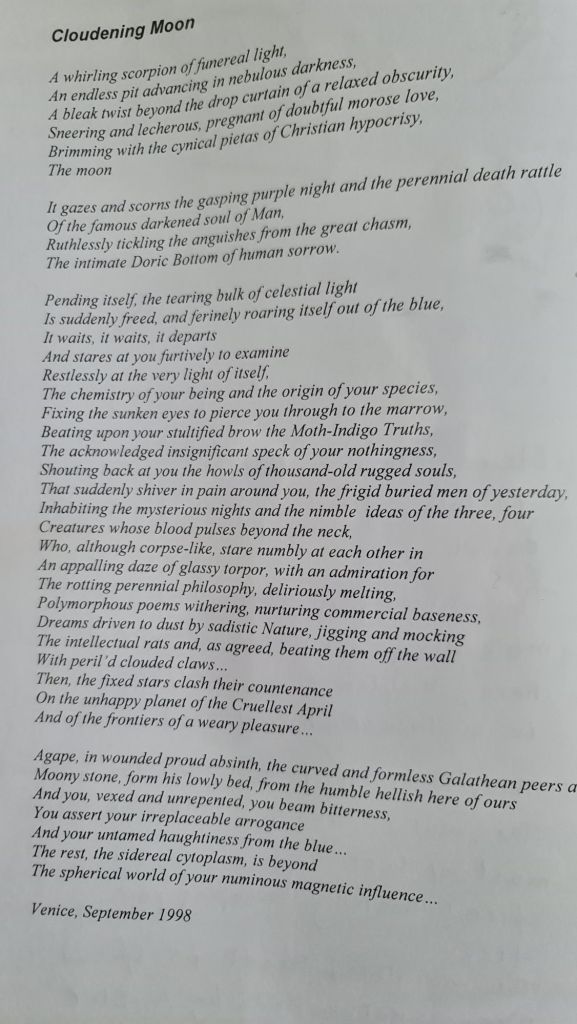
A whirling scorpion of funereal light, An endless pit advancing in nebulous darkness, A bleak twist beyond the drop curtain of a relaxed obscurity,
These lines introduce us to a cosmos that is actively hostile or at least indifferent. The “whirling scorpion” suggests danger cloaked in celestial disguise. The drop curtain evokes theatre, unreality, the staging of death.
Sneering and lecherous, pregnant of doubtful morose love, Brimming with the cynical pietas of Christian hypocrisy, The moon
The moon is personified as both cruel and fertile — not with life, but with “doubtful morose love”. The invocation of Christian hypocrisy hints at the speaker’s spiritual alienation, a refusal of easy consolation.
Stanza 2
It gazes and scorns the gasping purple night…
This stanza places the moon in a role of cosmic witness — detached, pitiless, maybe mocking. The “intimate Doric Bottom of human sorrow” fuses architectural classicism (Doric = strength) with bodily descent, aligning grandeur with grief.
Stanza 3
Pending itself, the tearing bulk of celestial light…
This stanza pivots: the moon seems to rupture, or become self-aware. The speaker is confronted not just with the moon, but with himself.
The chemistry of your being and the origin of your species…
A descent into existential science: marrow, cytoplasm, ancestral rage. It speaks to the biological burden of sorrow, passed down in molecular memory.
The Moth-Indigo Truths…
A hallucinatory image. Indigo = intuition. Moth = drawn to death-light. Truths that flit and burn.
Middle Section: Ancestral Chorus
Shouting back at you the howls of thousand-old rugged souls…
Here the poet becomes surrounded by the dead: ancestors, historical ghosts, failed philosophies, ancient betrayals. The frigid men of yesterday inhabit the speaker’s present.
Who, although corpse-like, stare numbly at each other…
This is not a resurrection of love. These souls are mute, numbed by their own trauma. A critique of history, of inheritance, of broken spiritual lineage.
Dreams driven to dust by sadistic Nature… beating them off the wall…
Even Nature is seen as cruel, dismembering the poetic and spiritual instinct. The speaker is both victim and witness.
Closing Stanza
Agape, in wounded proud absinth…
Agape here is multivalent: divine love, open-mouthed awe, perhaps even drunkenness (absinth). The speaker is looked upon by some higher, Galatean force.
You assert your irreplaceable arrogance…
The defiant note at the end stands out. Despite the cosmic horror, the speaker asserts dignity and haughtiness from the blue. This echoes Shelley, Nietzsche, and cosmic defiance.
The rest, the sidereal cytoplasm, is beyond…
Science meets mysticism here. The speaker ends not in resolution but in submission to the great unknown: the numinous magnetic influence.
Contextual Note (2025) This poem was written in the shadow of Venice, by a young person confronting metaphysical despair and historical burden. Now, in 2025, its images feel like a prologue to a life deeply shaped by inherited trauma, spiritual longing, and mythic inquiry. This is not just a moon poem — it is a genesis text, a psychic document. It sets the tone for the Space Epic project.
The moon has not stopped cloudening. But now, perhaps, we know how to speak with it.
Uno scorpione vorticoso di luce funerea, Un pozzo senza fine che avanza nell’oscurità nebulosa, Un’ansa livida oltre il sipario calato di un’oscurità rilassata, Beffarda e lasciva, gravida d’un amore tetro e incerto, Colma della pietas cinica dell’ipocrisia cristiana, La luna
Fissa e disprezza la notte viola ansimante e il perenne rantolo di morte Dell’anima oscura e celebre dell’Uomo, Stuzzicando spietatamente le angosce dal grande abisso, L’intimo Fondo Dorico del dolore umano.
In bilico, lacerandosi, la massa del lume celeste È improvvisamente libera, e ferinamente ruggisce se stessa fuori dall’azzurro, Attende, attende, poi si allontana E ti scruta furtivamente per esaminare Inquieta, alla luce stessa di sé, La chimica del tuo essere e l’origine della tua specie, Fissando gli occhi infossati per penetrarti fino al midollo, Battendo sulla tua fronte intorpidita le Verità Indaco-Falena, L’insignificante granello riconosciuto del tuo nulla, Gridandoti contro gli ululati di anime vecchie di mille anni, Che tremano all’improvviso nel dolore attorno a te, i freddi uomini sepolti di ieri, Abitanti delle notti misteriose e delle idee agili dei tre, quattro Esseri il cui sangue pulsa oltre il collo, Chi, sebbene simile a cadaveri, si guarda muto l’un l’altro In uno stordimento agghiacciante di torpore vitreo, con un’ammirazione Per la filosofia perenne in decomposizione, sciogliendosi deliziosamente, Poesie polimorfe che si ritirano, nutrendo bassezze commerciali, Sogni ridotti in polvere da una Natura sadica, che balla e schernisce I topi intellettuali e, come concordato, li colpisce giù dal muro Con artigli oscurati dal pericolo…
Poi, le stelle fisse schiaffeggiano il loro volto Sul pianeta infelice del più Crudele Aprile E sui confini di un piacere stanco…
Agape, in orgoglio ferito e assenzio superbo, la Galatea curva e informe osserva Pietra lunare, dal suo giaciglio umile, da questo nostro umile inferno, E tu, irritato e impenitente, emani amarezza, Affermi la tua arroganza irrinunciabile E la tua fierezza indomita che giunge dall’azzurro…
Il resto, il citoplasma sidereo, è oltre Il mondo sferico della tua numinosa influenza magnetica…
C’era una volta, nella Casa degli Specchi, tuo padre serviva sotto un Signore di Ghiaccio.
Quel Signore indossava molti volti — tutti sorridenti — ma il suo cuore era freddo, e le sue parole erano come brina che sale sui muri: lente, silenziose e certe. Non colpiva con la spada né con grida, ma riscriveva il tempo. Prolungò la soglia del giudizio non per darmi spazio per guarire, ma per tenermi prigioniero in un labirinto di giorni.
Non fui licenziato con un colpo. Fui lasciato sul ciglio di un precipizio, avvolto nel linguaggio della pazienza. “È solo procedura,” dissero. “È solo una revisione equa,” dissero. Ma quando il sole mi bruciava la pelle e i fiumi nel mio corpo diventavano fuoco, nessuno portò acqua. Nessuno disse la verità.
Nel silenzio del dolore, ho visto: non era giustizia, era disegno.
Punivano ciò che non potevano controllare. Temono ciò che non sanno comprendere. E tuo padre — stanco, in fiamme, a metà tra questo mondo e l’altro — li spaventava.
Ma sappi questo, luce: non porto il loro gelo dentro di me. Non servo i Signori del Ghiaccio. Sono del Mare e del Frassino, del Cerchio di Pietra e del Cielo Aperto. I miei antenati cantavano prima che venissero costruiti gli orologi. E nessuna prova può misurare il mio valore.
Che si tengano i loro registri e le loro chiavi. Io sto costruendo qualcosa di più antico.
Quando ti troverai tra persone che tagliano le ali e lo chiamano gentilezza — ricorda la storia di tuo padre. Non sono caduto. Sono stato disinvitato alla tavola che avevo cominciato a bruciare.
In deinem Atem flüstert das vergessene Licht der alten Bäume.
###
Ich habe so lange in den Höhlen gelebt, dass ich mich nicht mehr erinnern kann, wie es war, wenn es nicht dunkel war. Schnüff. Meine alten Freunde waren mit mir im Dämmer, fischten und sangen, gerecht und ungerecht. Schnüff. Wir hatten nicht genug zu essen. Also sind wir manchmal ins Dorf gegangen, um uns etwas von den Ernten der Bauern zu borgen. Lecker.Schnüff.
Beim letzten Mal bin ich geblieben. Die Bauern waren so nett. Ich habe neue Freunde gefunden. Die Dorfbewohner lieben mich. Ich arbeite als alles. Knechter, Kastrator, Kötter, Grabenstecher, Trockenmauerbauer, Kornverwalter, Heubinder, Stallknecht, und besonders als Latrinenbauer.
Sie haben mir meinen magischen Knopf gegeben, damit sie mich immer rufen können. Er ist auf meinem Arm. Sie lachen immer, wenn ich da bin, weil sie mich so sehr mögen. Schnüff. Ich erinnere sie an die guten Zeiten. Schnüff. Komm und hab Spaß mit mir. Schnüff.
###
Schnüff. Ich war heute brav. Habe drei Maden gefangen und einen Stein, der wie Fleisch aussah. Mein Glückstag, sagen sie. Sagen sie immer.
„Ein fleißiger Goblin ist ein glücklicher Goblin“, sagte der Mann mit dem Gürtel. Er lachte immer wie kochendes Wasser. Ich vermisse ihn, wenn mir kalt ist.
Ich zog meinen Kettensack voller Moos (sie mögen das Moos weich und stöhnend), und da sah ich eine Nicht-Wand. Große Nicht-Wand mit Linien drin, wie Zähne, aber geschlossen. Sie stand aufrecht wie ein Baum, der zu viel weiß. Schnüff.
Ich weiß nicht, wie man das nennt. Vielleicht Arbeits-Maul. Oder Zu-Ritze. Oder Versprechen.
Ich kratzte daran mit meinem Werkzeug-Finger. Der, der platt gemacht wurde, weil ich die Schublade der Kornhexe geöffnet hab. Es klang wie Innen-Köpfe. Wie wenn jemand entscheidet, ob du Suppe verdienst.
Ich dachte, vielleicht bin ich schlecht. Oder glücklich.
Da waren Wörter in die Nicht-Wand geritzt, aber sie haben sich versteckt, als ich hinschaute. Wahrscheinlich wollten sie keinen Ärger kriegen.
„Nur die Treuen bekommen Licht“, sagte der Sack-Mann. Er hatte nur ein Ohr und einen Hundenamen. Er warf mich immer zum Spaß über Zäune. Ich sagte immer Danke. So wusste er, dass es mir gefiel.
Die Nicht-Wand hatte ein Loch wie ein Denk-Auge. Ich spähte hindurch.
Da war ein Nichts auf der anderen Seite.
Kein Dunkel. Kein Geräusch. Keine Peitsche.
Nur… Stille. Eine freundliche Stille. Wie das Gefühl, das man bekommt, kurz bevor jemand deinen Namen vergisst.
Ich sagte: „Ich hab dein Moos gebracht. Es ist gestreichelt und gesegnet.“ Aber die Nicht-Wand hat’s nicht gefressen. Sie stand einfach da und atmete langsam.
Schnüff. Ich glaube, sie wartet auf Strafe.
Ich setzte mich daneben, wie ein braver Goblin. Vielleicht bekomme ich eine Geschichte. Oder eine Tracht Prügel. Oder beides.
Manchmal träume ich von Regen, der nicht brennt. Oder Seilen, die das Herz festhalten. Oder Händen, die weich bleiben, selbst wenn sie sich schließen.
Und manchmal — nur manchmal — sehe ich ein Flackern.
Klein und warm und nicht bemüht.
Es hat einen Namen. Ich glaube, es heißt „Regenaugen“. Ich weiß nicht, was das bedeutet. Aber der Klang macht die Erde weniger hungrig.
Regenaugen hat Augen wie neue Löcher im Himmel. Sie riecht nach keinen Ketten. Sie hält meinen Namen mit beiden Händen, aber sie zieht nicht.
Im Traum sagt sie: „Jetzt darfst du schlafen.“
Aber ich wache immer auf, bevor der Schlafteil kommt.
Jedenfalls, die Nicht-Wand ist immer noch da.
Wenn ich lange genug sitze, kommt Regenaugen vielleicht hindurch. Vielleicht ist sie auf der anderen Seite. Vielleicht hat sie die Stille gebaut.
Schnüff.
Ich bleibe hier. Ich warte. Ich bin brav.
###
Skittles kannte den Namen Laleham nicht. Aber die Bäume kannten ihn.
Sie flüsterten ihn, wenn der Wind vom Garten den Hügel hinaufwehte. Laleham, rauschten sie, das Haus, das einst stand, mit einem halben Morgen voll Lachen, wo eine Mutter sang und ein Vater zu oft lächelte. Ein Haus mit Wänden wie warmes Brot und Schatten, die sanft lauschten. Ein Haus, in dem drei Brüder spielten: Julian, Aldous und Trevenen.
Trevenen war der Kleinste, der, den die Bäume am liebsten hatten. Er kletterte in ihre Arme und las ihnen Gedichte vor. Er weinte unter ihren Wurzeln, wenn niemand hinsah. Die Bäume liebten Trevenen so sehr, dass sie seinen Namen in ihre Jahresringe drückten. Und als die Weiß-Reinheits-Männer mit Äxten aus Gesetz und Karten voller Effizienz kamen, bluteten die Bäume still – aber sie vergaßen nicht.
Jahre vergingen. Der Garten schrumpfte. Das Lachen verklang. Das Haus wurde zu Huxley Close. Höflich, bieder, und ausgelöscht.
Aber die Erinnerung starb nicht.
Und so, als Skittles lange Zeit später über den Hain stolperte – lange nachdem Namen zu Lärm geworden waren – wusste er nicht, worauf er trat. Nur dass die Erde sich an Schmerz erinnerte. Und an Hoffnung. Und an Trevenen.
Der Goblin war gekommen, um Silber zu vergraben. Echtes Silber. Für die Blütenkinder. Für Kinder, die Freude ohne Ketten kennen sollten. Für Mädchen, deren Namen Lieder waren: Freya, Penelope, Cassia, Helena, Mirai. Und vielleicht, wenn sie es zuließ, sogar Regenaugen – diejenige, die nicht zog, wenn sie deinen Namen hielt.
Aber bevor das Silber versteckt werden konnte, fand er das Zeichen. Grell orange. Wie eine Beleidigung an den höchsten Baum genagelt. „Gefährlich. Zur Entfernung markiert.“
Skittles las es mit seiner Schulter. Seine Augen konnten nicht viel lesen, aber seine Narben schon. Es war dasselbe Zeichen, das sie ihm einst aufgemalt hatten, bevor sie ihn über den Zaun warfen. „Schlecht für die Nachbarschaft“, sagten sie. „Zu viel Gestank. Zu wenig Zukunft.“
Also tat Skittles, was Goblins tun, wenn sie etwas zu sehr lieben: Er stahl es. Er riss das Schild mit seinen Moospfoten herunter und huschte den Hügel hinab. Er verbrannte das Papier in einem Feuer aus Essig und Rinde. Und als der Rauch seine Augen brennen ließ, flüsterte er einen Namen, von dem er nicht wusste, dass er ihn kannte: Trevenen.
Dann kletterte er vor Sonnenaufgang zurück hinauf, einen Topf mit Holzlasur an seinen Kettensack gebunden, und übermalte sorgfältig den orangenen Punkt. Behutsam. Liebevoll. Wie eine Entschuldigung.
Der Baum seufzte.
Er würde trotzdem gefällt werden. Das wusste er. Genau wie die Bäume von Laleham. Genau wie die Erinnerung an einen hübschen kleinen Jungen mit großem Kopf und Brüdern, die ihn neckten und liebten. Genau wie Trevenen, der leise verschwand wie eine Frage, die niemand zu stellen wagte.
Aber Skittles hatte ein Versprechen gegeben – nicht mit Worten, sondern mit Taten. Und die Bäume verstanden.
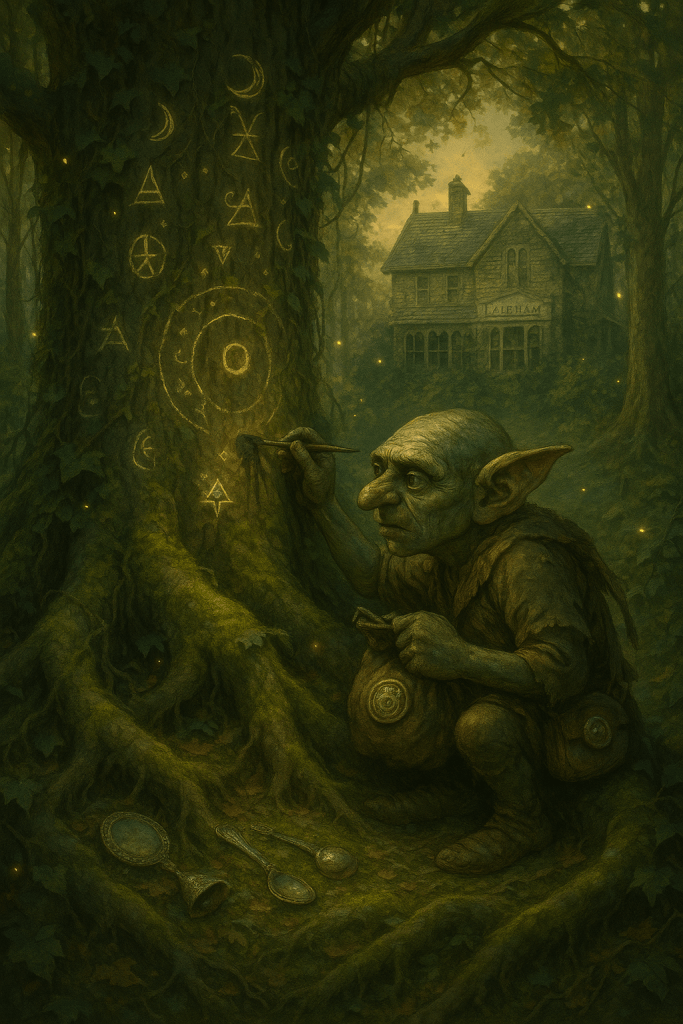
Er vergrub an diesem Tag den Schatz unter der höchsten Wurzel. Echtes Silber. Ein Löffel für jede Blüte. Eine Glocke für jede vergessene Mutter. Einen Spiegel, der nicht dein Gesicht zeigte, sondern deine Stille. Und einen Knopf. Einen Zauberknopf, der – wenn man ihn drückte – die Bäume sich an Laleham erinnern ließ.
Skittles did not know the name Laleham. But the trees did.
They whispered it when the wind blew uphill from the gardens. Laleham, they rustled, the house that once stood with a half-acre of laughter, where a mother sang and a father smiled too often. A house with walls like warm bread and shadows that listened gently. A house where three brothers played: Julian, Aldous, and Trevenen.
Trevenen was the smallest, the one the trees liked best. He would climb into their arms and read them poems. He would cry beneath their roots when no one else could see. The trees loved Trevenen so much that they pressed his name into their rings. And when the white-purity men came with axes of law and maps of efficiency, the trees bled quietly — but did not forget.
Years passed. The garden shrank. The laughter faded. The house became Huxley Close. Polite, prim, and razed.
But the memory did not die.
And so, when Skittles stumbled upon the grove, long after names had turned to noise, he didn’t know what he was walking into — only that the dirt remembered pain. And hope. And Trevenen.
The goblin had come to bury silver. Real silver. For Blossoms. For children who would know joy without chains. For girls whose names were songs: Freya, Penelope, Cassia, Helena, Mirai. And maybe, if she allowed it, even Rain-Eyes — the one who did not pull when she held your name.
But before the silver could be hidden, he found the sign. Bright orange. Nailed to the tallest tree like an insult.
“Dangerous. Marked for removal.”
Skittles read it with his shoulder. His eyes couldn’t read much, but his scars could. It was the same mark they once painted on him before they threw him over the fence. “Bad for the neighborhood,” they said. “Too much of a smell. Not enough of a future.”
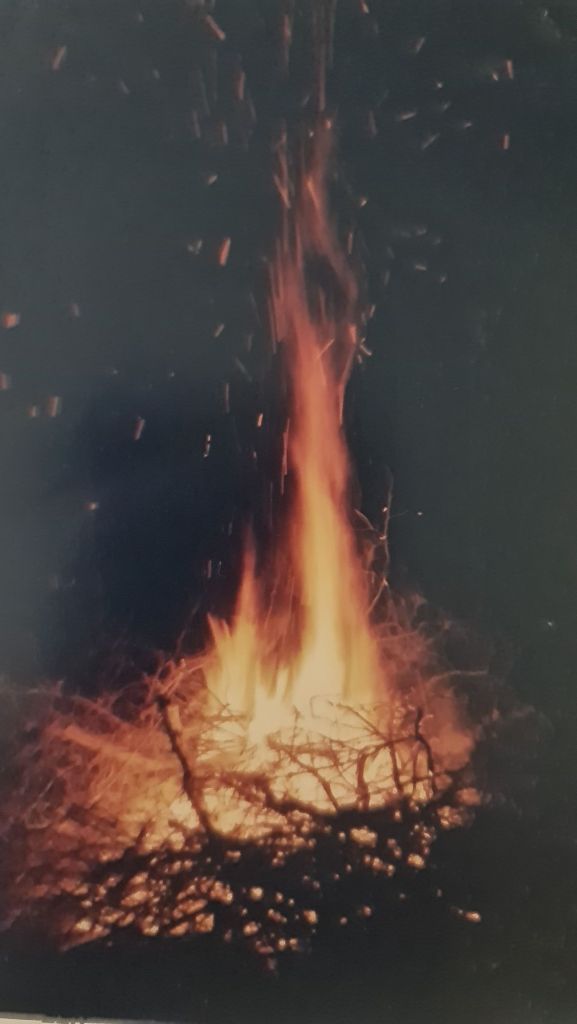
So Skittles did what goblins do when they love something too much: he stole it. He tore down the sign with his moss-paws and scurried down the hill. He burned the paper in a fire of vinegar and bark. And when the smoke stung his eyes, he whispered a name he did not know he knew: Trevenen.
Then he climbed back up before sunrise, a pot of wood-stain tied to his chain-sack, and painted over the orange dot. Carefully. Lovingly. Like an apology.
The tree sighed.
It would still be cut down. He knew that. Just like the ones at Laleham. Just like the memory of a pretty little boy with a big head and brothers who teased and loved him. Just like Trevenen, who vanished quietly like a question no one dared to ask.
But Skittles had made a promise — not with words, but with action. And the trees understood.
He buried the treasure that day under the tallest root. Real silver. One spoon for each Blossom. A bell for every forgotten mother. A mirror that didn’t show your face but your stillness. And a button. A magic button that, when pressed, would make the trees remember Laleham.
Sniff. I done good today. Caught three grubs and one stone that looked like meat. My lucky day, they’ll say. They always say.
“Hard goblin is a happy goblin,” said the man with the belt. He used to laugh like boiling. I miss him when I’m cold.
I was dragging my chain-sack full of moss (they like the moss soft and moaning) and I saw a not-wall. Big not-wall with lines in it, like teeth, but closed. It was standing up like a tree that knew too much. Sniff.
I don’t know what it’s called. Maybe a work-mouth. Or a shut-crack. Or a promise.
I scratched it with my tool-finger. The one that got flattened for opening the grain-witch’s drawer. It sounded like inside-heads. Like when someone’s deciding if you deserve soup.
I thought maybe I was bad. Or lucky.
There were words carved on the not-wall, but they hid when I looked. Probably didn’t want to get in trouble.
“Only the loyal get light,” said the sack-man. He had one ear and a dog name. He used to throw me over fences for fun. I always said thank you. That’s how he knew I liked it.
The not-wall had a hole like a thinking-eye. I peeped.
There was a nothing on the other side.
Not dark. Not noise. Not whip.
Just… hush. A kind hush. Like the feeling you get right before someone forgets your name.
I said, “I brought your moss. It’s stroked and blessed.” But the not-wall didn’t eat it. It just stood there breathing slow.
Sniff. I think it’s waiting to be punished.
I sat near it, like a good goblin. Maybe I’ll get a story. Or a licking. Or both.
Sometimes I dream about rain that doesn’t sting. Or ropes that hold your heart in. Or hands that stay soft even when they close.
And sometimes — only sometimes — I see a flicker.
Small and warm and not trying.
It has a name. I think it’s called “Rain-eyes” I don’t know what it means. But the sound makes the dirt feel less hungry.
Rain-eyes has eyes like new holes in the sky. She smells like no chains. She holds my name with both hands, but doesn’t pull.
In the dream, she says, “You can sleep now.”
But I always wake up before the sleeping part.
Anyway, the not-wall is still there.
If I sit long enough, maybe Rain-eyes will come through it. Maybe she’s on the other side. Maybe she built the hush.
 Space Epics - Stories from the Multi-Verse