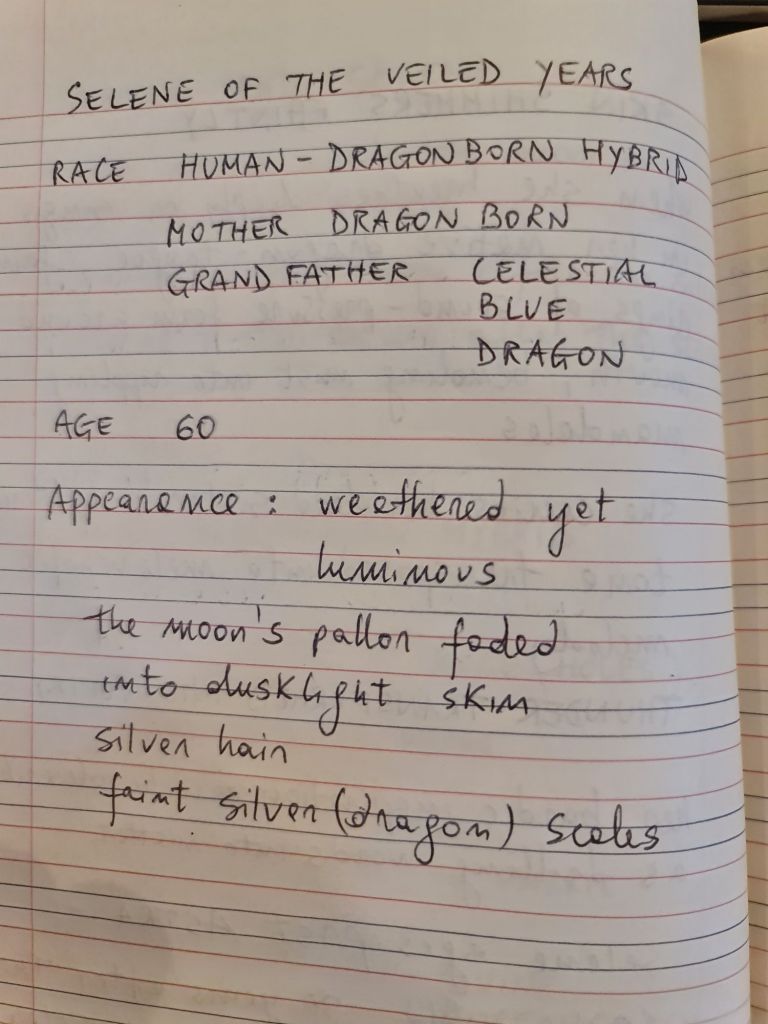
Human–Dragonborn Bard (College of Spirits) Age 60 · Neutral Good · Voice of the Remembered
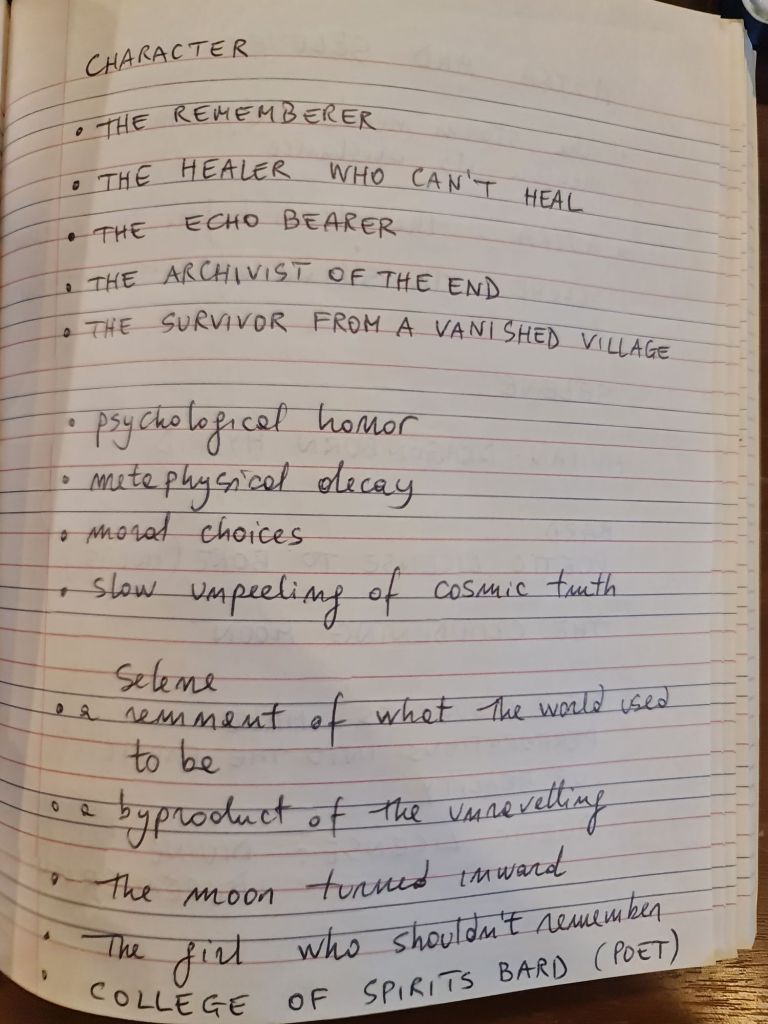
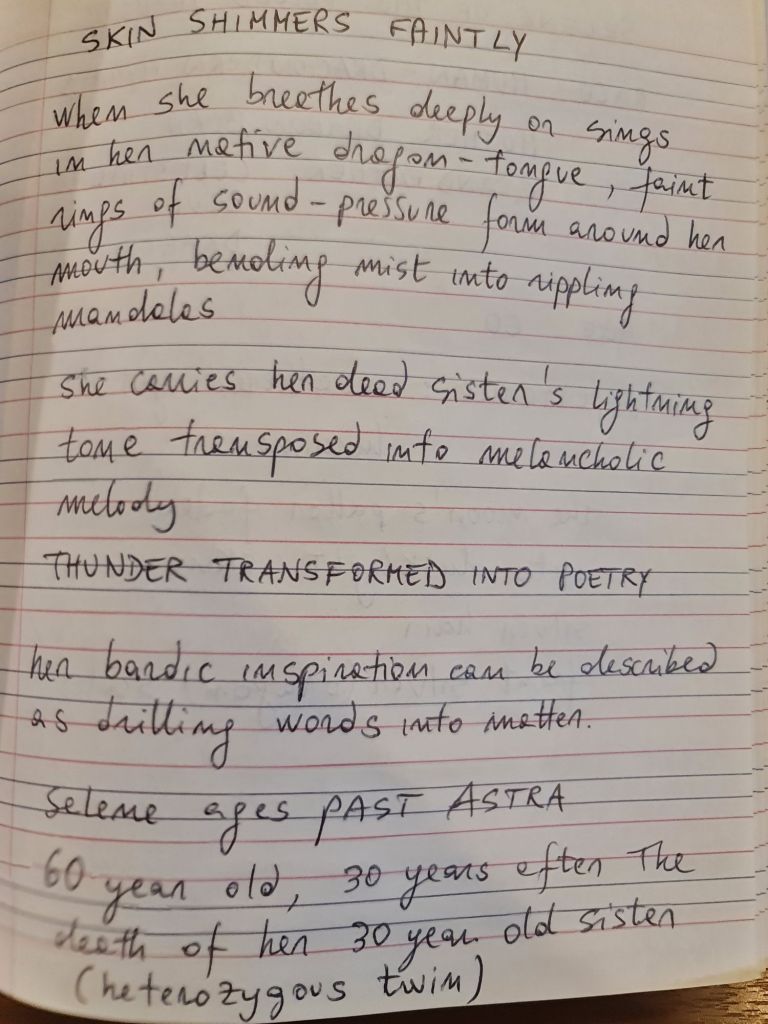
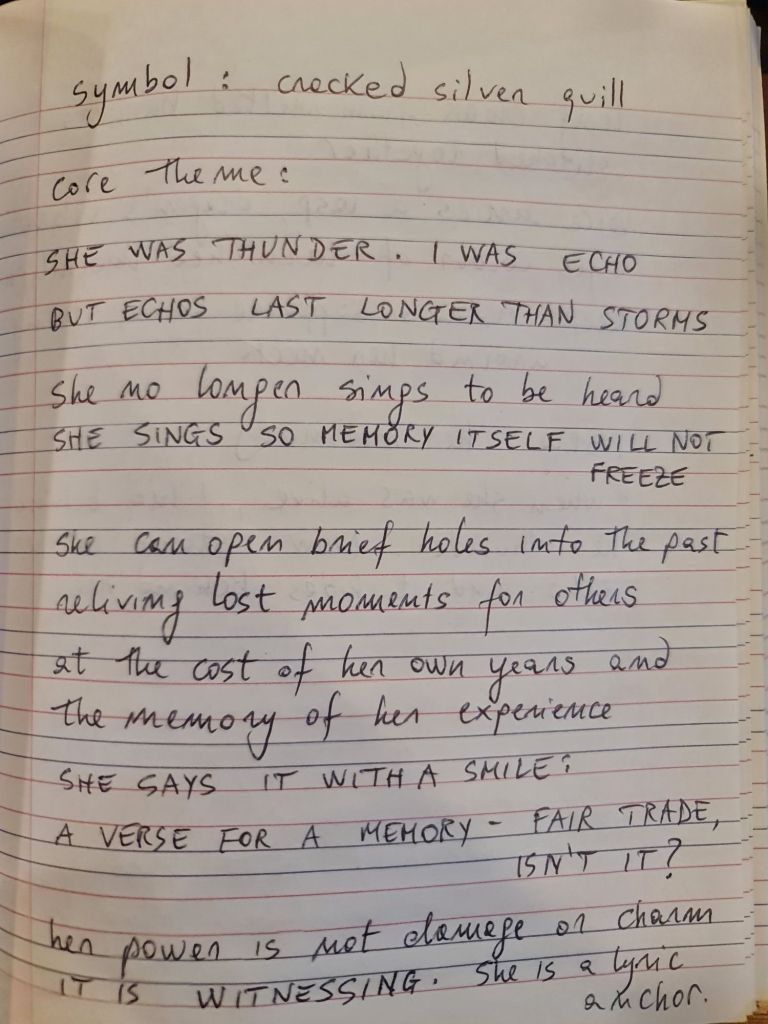
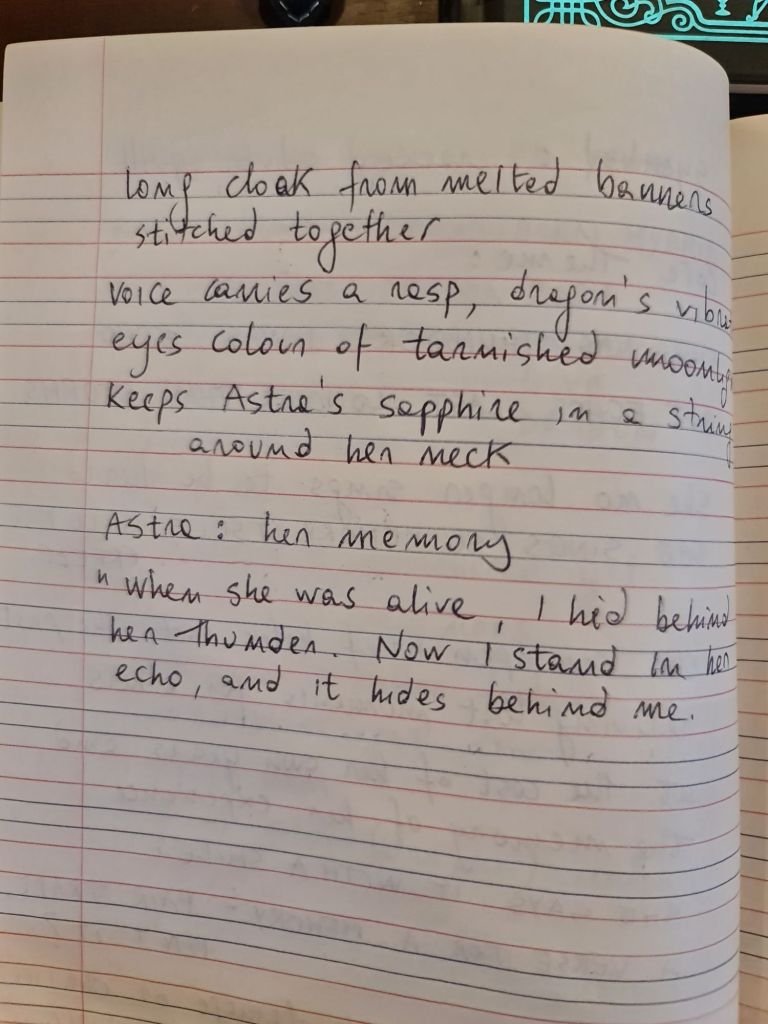
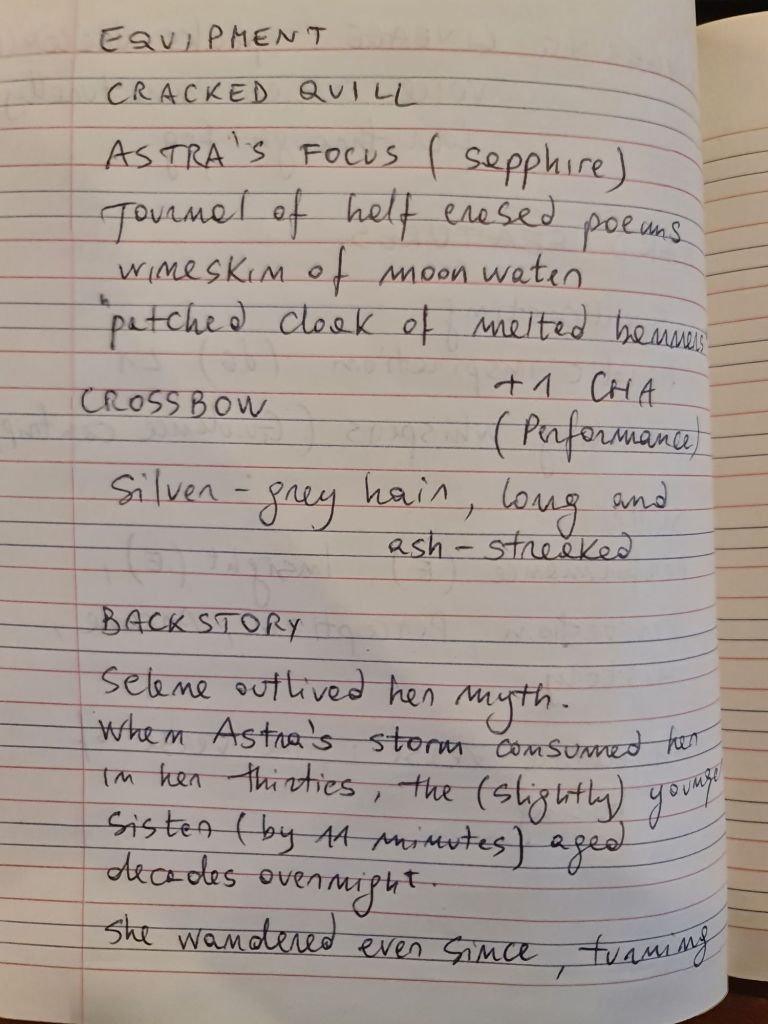
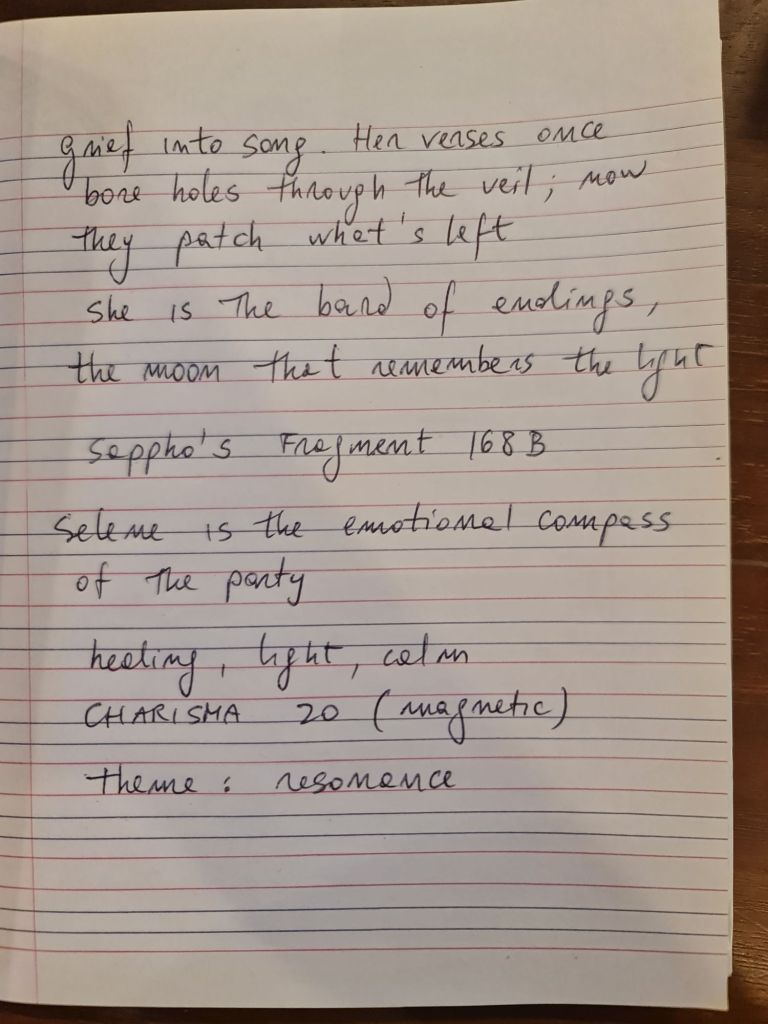
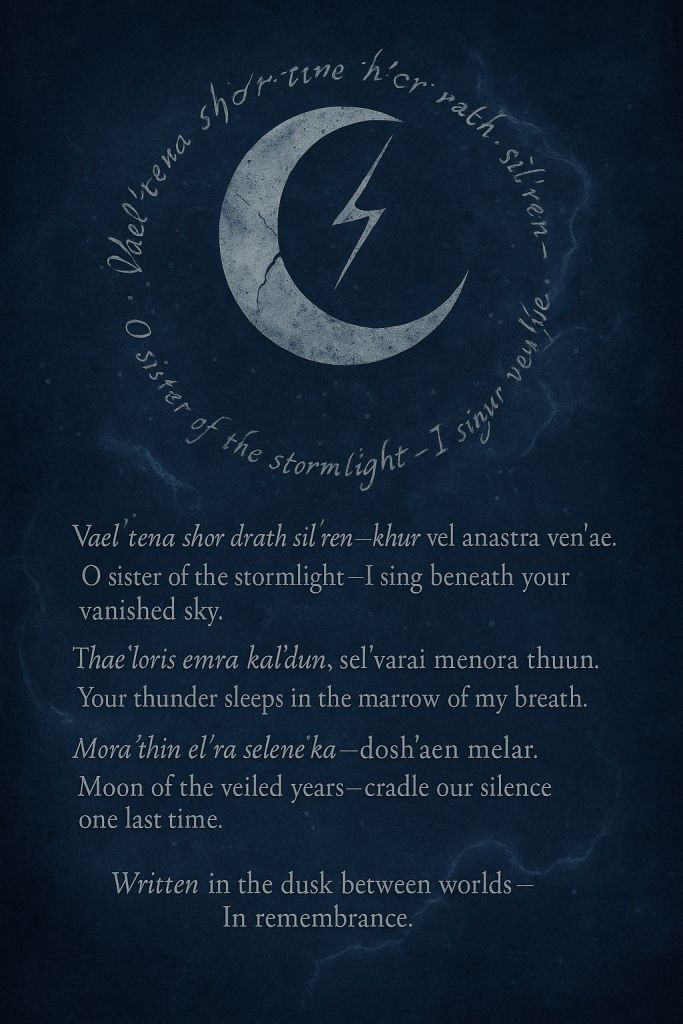
Once the younger sister of the stormborn Astra, Selene survived what her sister could not. Where Astra burned bright and fast, Selene endured — her fire turned inward, her music made of echoes and memory. Half human and half dragon, she now wanders a world unraveling, carrying her sister’s sapphire at her throat and a book of songs no one remembers how to sing.
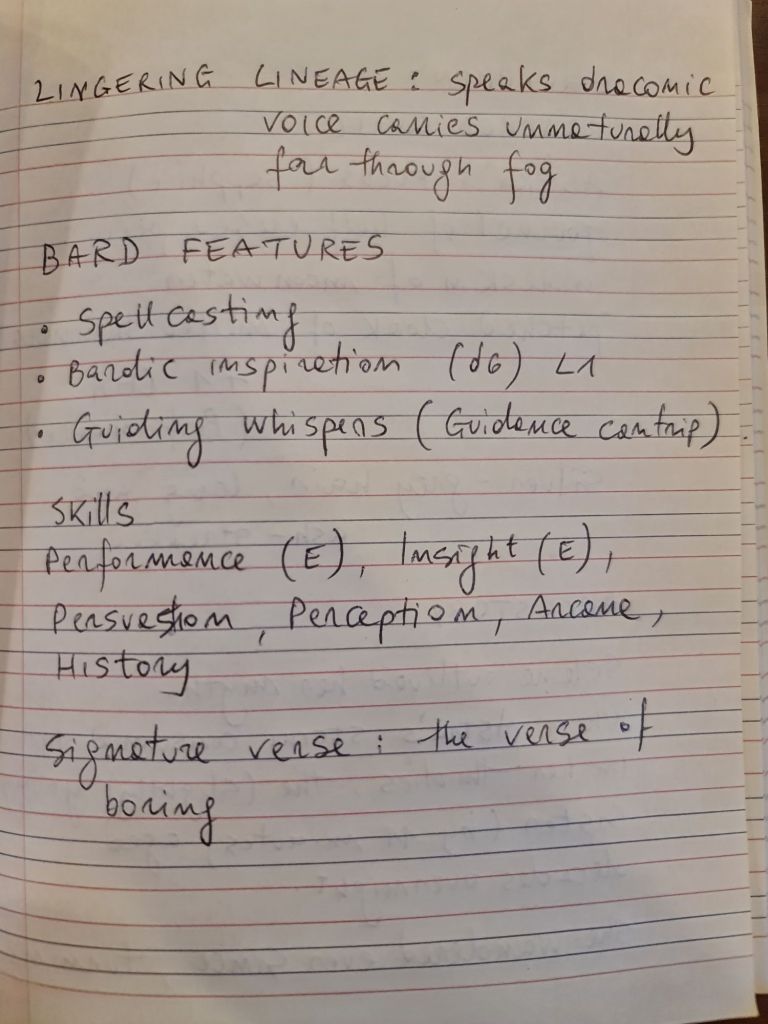
Her bardic gift is not simple performance. When Selene sings, forgotten spirits stir; when she stops, silence itself seems to listen. Her voice is said to mend the edges of dreams, or sometimes tear them wider. She travels light, speaks little, and writes by moonlight in a tongue half her own and half the dead’s.
Those who meet her remember the stillness more than the words — a feeling that someone was listening to the world itself breathe.
“I’m Selene — once a singer, now mostly an echo. My sister Astra was the storm; I’m what’s left when the thunder fades. I travel with her sapphire and a few songs the world forgot. If I seem quiet, it’s only because I’m listening — the sky has been trying to speak again.”
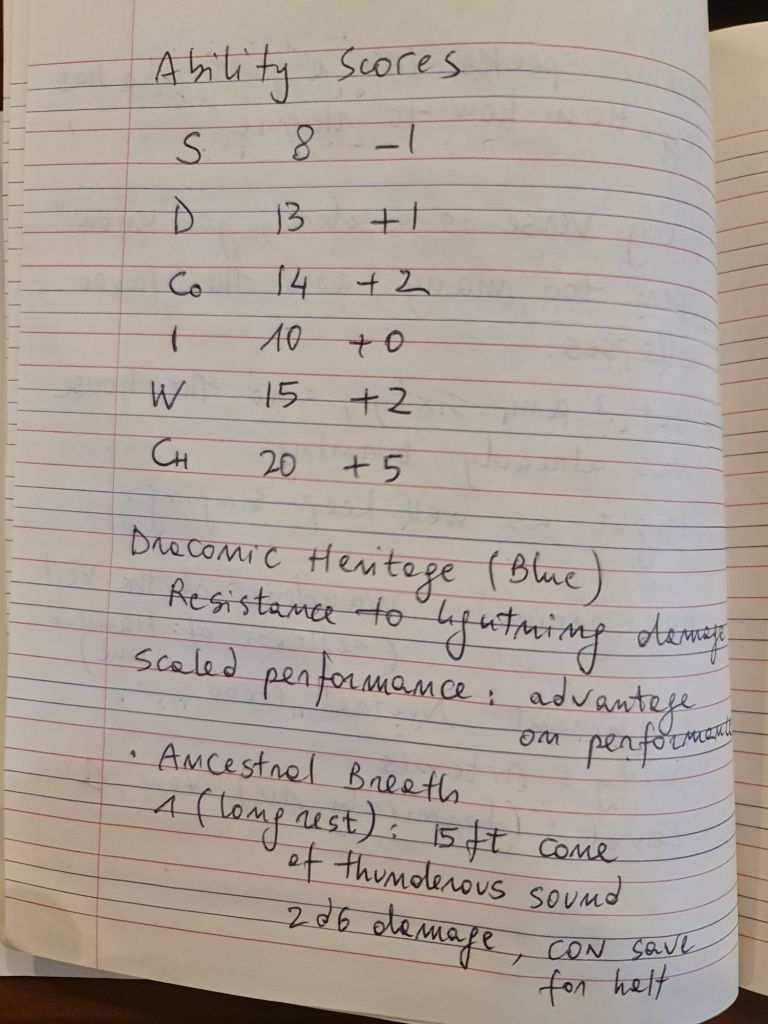
Selene is a Bard (d8 Hit Die), with Constitution 14 (+2 modifier).
Selene at this stage is already preternaturally gifted: her voice and presence are her defense, not her blade
Cantrips: Vicious Mockery, Minor Illusion, Message 1st-Level Spells Known (4): • Cure Wounds — healing through harmonic resonance. • Faerie Fire — moonlight revealing truth. • Dissonant Whispers — the first stirring of the “Verse of Boring.” • Detect Magic — tuning into the world’s faint unraveling hum.
Narrative Position – The First Light after Loss
Again at Level 1 after partial massive memory loss, Selene has only just stepped beyond the ashes of her sister’s storm. She is:
In exile from her past life. The bard who once sang in courts now sings to ruins and forgotten graves.
Haunted. Astra’s sapphire hums faintly, but its full resonance lies dormant.
Drawn to the unraveling. She senses the world’s sickness — whispers under moonlight that sound too much like memory.
Rooted in silence. Her songs are sparse, half-prayer, half-warning; when she stops, the world seems to hush in answer.
Psychological and Emotional State
Loss: Astra’s death is fresh; Selene still half expects her sister’s voice to answer.
Purpose: Unclear — she travels because standing still feels like dying again.
Gift or curse: Her music touches spirits; she’s not sure whether she’s invoking them or they’re invoking her.
Manner: Gentle, wry, composed on the surface — the still eye of an unseen storm.
Night lay beyond the walls of the Chemical Institute, the night of Europe: Chamberlain had returned from Munich duped, Hitler had marched into Prague without firing a shot, Franco had subdued Barcelona and was ensconced in Madrid. Fascist Italy, the small-time pirate, had occupied Albania, and the premonition of imminent catastrophe condensed like grumous dew in the houses and streets, in wary conversations and dozing consciences. But the night did not penetrate those thick walls; Fascist censorship itself, the regime’s masterwork, kept us shut off from the world, in a white, anesthetized limbo. About thirty of us had managed to surmount the harsh barrier of the first exams and had been admitted to the second year’s Qualitative Analysis laboratory. We had entered that enormous, dark, smoky hall like someone who, coming into the House of the Lord, reflects on each of his steps. The previous lab, where I had tackled zinc, seemed an infantile exercise to us now, similar to when as children we had played at cooking: something, by hook or crook, in one way or another, always came of it, perhaps too little, perhaps not very pure, but you really had to be a hopeless case or pigheaded not to get magnesium sulfate from magnesite, or potassium bromide from bromine. Not here: here the affair had turned serious, the confronta- tion with Mother-Matter, our hostile mother, was tougher and closer. At two in the afternoon, Professor D., with his ascetic and distracted air, handed each of us precisely one gram of a certain powder: by the next day we had to complete the qualitative analysis, that is, report what metals and non-metals it contained. Report in writing, like a police report, only yes and no, because doubts and hesitations were not admissible: it was each time a choice, a deliberation, a mature and responsible undertaking, for which Fascism had not prepared us, and from which emanated a good smell, dry and clean. Some elements, such as iron and copper, were easy and direct, incapable of concealment; others, such as bismuth and cadmium, were deceptive and elusive. There was a method, a toilsome, ageold plan for systematic research, a kind of combined steamroller and fine-toothed comb which nothing (in theory) could escape, but I preferred to invent each time a new road, with swift, extemporaneous forays, as in a war of movement, instead of the deadly grind of a war of position. Sublimate mercury into droplets, transform sodium into chloride, and identify it as trough-shaped chips under my microscope. One way or another, here the relationship with Matter changed, became dialectical: it was fencing, a face-to-face match. Two unequal opponents: on one side, putting the questions, the unfledged, unarmed chemist, at his elbow the textbook by Autenrieth as his sole ally (because D., often called to help out in difficult cases, maintained a scrupulous neutrality, refused to give an opinion: a wise attitude, since whoever opens his mouth can put his foot in it, and professors are not supposed to do that); on the other side, responding with enigmas, stood Matter, with her sly passivity, ancient as the All and portentously rich in deceptions, as solemn and subtle as the Sphinx. I was just beginning to read German words and was enchanted by the word Urstoff (which means “element”: literally, “primal sub- stance”) and by the prefix Ur which appeared in it and which in fact expresses ancient origin, remote distance in space and time. In this place, too, nobody wasted many words teaching us how to protect ourselves from acids, caustics, fires, and explo- sions; it appeared that the Institute’s rough and ready morality counted on the process of natural selection to pick out those among us most qualified for physical and professional survival. There were few ventilation hoods; each student, following his text’s prescriptions, in the course of systematic analysis, consci- entiously let loose into the air a good dose of hydrochloric acid and ammonia, so that a dense, hoary mist of ammonium chloride stagnated permanently in the lab, depositing minute scintillating crystals on the windowpanes. Into the hydrogen sulfide room with its murderous atmosphere withdrew couples seeking privacy and a few lone wolves to eat their snacks. Through the murk and in the busy silence, we heard a Piedmontese voice say: “Nuntio vobis gaudium magnum. Habemus ferrum.” “I announce to you a great joy. We have iron.” It was March 1939, and a few days earlier an almost identical solemn announcement (“Habemus Papam”) had closed the conclave that had raised to Peter’s Throne Cardinal Eugenio Pacelli, in whom many put their hopes, since one must after all put one’s hope in someone or something. The blasphemous announcement came from Sandro, the quiet one. In our midst, Sandro was a loner. He was a boy of medium height, thin but muscular, who never wore an overcoat, even on the coldest days. He came to class in worn corduroy knickers, knee socks made of homespun wool and sometimes a short black cape which made me think of the Tuscan poet Renato…
Green, white, and red once dreamed of bread, of workers freed from king and creedThirteen stripes in red and white, rose for a world that would not bowTaught without meaning, again and again — We name the colours, forget the pain. Taught without meaning, again and again — Until we teach what freedom meant then
Refrain (spoken or sung softly) Taught without meaning, again and again — We name the colours, forget the pain.
I. The Flag of the Fields Green, white, and red once dreamed of bread, of workers freed from king and creed, a flag that spoke of fields instead of crowns and swords and noble need.
Taught without meaning, again and again — We name the colours, forget the pain.
II. Guido Fawkes (1570–1606) Guido Fawkes, born 1570, was racked in chains beneath the floor; his body torn for what he planned— to strike the crown, to end the war.
They burned his name into the night, and made his ashes holiday; they light the sky, but never tell whose body paid for that display.
Taught without meaning, again and again — We light the fireworks, forget the men.
III. William Wallace (1270–1305) William Wallace, 1270 born, was dragged through London’s iron rain; they broke his limbs to teach the law, then scattered him by gate and chain.
Now children trace the Union’s cross, and cheer the tales of crown and land; they do not hear the cry he gave, or feel the rope on freedom’s hand.
Taught without meaning, again and again — We wave the banners, forget the chain.
IV. Thomas Paine (1737–1809) Thomas Paine, of Norfolk born, took pen against the crown of men; Common Sense became his sword, and liberty his citizen.
Thirteen stripes in red and white, rose for a world that would not bow; but stars can fade to painted signs when none recall the vow.
Taught without meaning, again and again — We pledge allegiance, forget the pain.
V. The Lesson So teachers hang the flags on walls, and speak of courage, not of cost; they praise the kings, the saints, the wars— and never ask what freedom lost.
Guido’s fire, William’s chain, Thomas’s bright ink on history’s page— they gave their flesh, their words, their names, and we were taught to turn the page.
Final Refrain (stronger, slower) Taught without meaning, again and again — We name the colours, forget the pain. Taught without meaning, again and again — Until we teach what freedom meant then.
Commentary
The poem’s purpose
This poem is a meditation on how nations turn pain into pageantry, and how children are often taught to revere symbols whose histories they are never invited to understand. It juxtaposes three moments of rebellion — Guy (Guido) Fawkes (1605), William Wallace (1305), and Thomas Paine (1776) — to trace a single lineage of resistance to hereditary power and state violence.
Each figure stands for a different kind of dissent:
Fawkes — punished by torture and death, remembered only as a villain or spectacle, his political motives flattened into a ritual of fireworks and obedience.
Wallace — executed publicly as a traitor, his body divided to warn others, yet later reabsorbed by empire as a symbol of “unity” rather than defiance.
Paine — a writer who used words rather than weapons, whose vision of liberty under reason and equality shaped the American Revolution — and yet, even his ideas have been domesticated into patriotic ritual.
By repeating the refrain “Taught without meaning, again and again,” the poem insists that history, in schools and in public life, is not neutral — it is curated forgetting. The refrain becomes a ritual undoing of that ritual: a call to remember the cost behind every colour and every flag.
The flags and their meanings
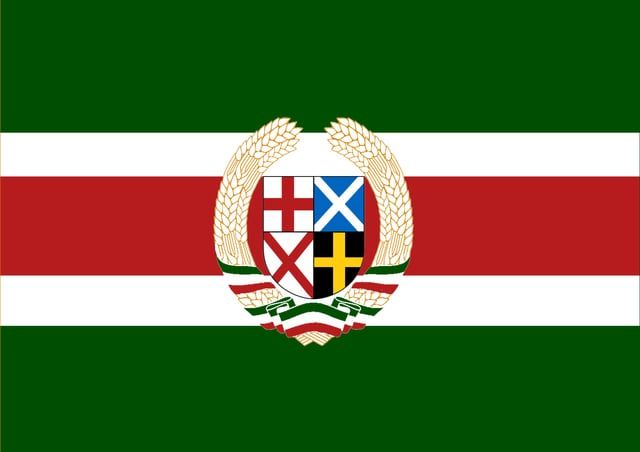
The first flag (green, white, red, with a wreath and quartered crosses)
This is the flag of the English People’s Republic — a speculative or symbolic banner imagined by anti-monarchists and republicans.
Green represents the land, labour, and renewal — the commons reclaimed from enclosure.
White stands for equality and peace between peoples.
Red evokes both the blood of the oppressed and the courage of revolt.
The wheat wreath signifies sustenance and work, the dignity of feeding oneself rather than serving a master.
The quartered shield bears crosses of England, Scotland, Ireland, and Wales — but they are no longer under a crown. They are held instead in the unity of the republic, bound by grain, not empire.
In the poem’s opening lines —
Green, white, and red once dreamed of bread, of workers freed from king and creed, the flag becomes an emblem of a different Britain — one that might have been and could still be, one built not on rule but on shared labour.
The second flag (thirteen stars and stripes)
The Betsy Ross flag — the first flag of the United States (1776–77). Originally a symbol of liberation from monarchy, it is now a paradox: a revolutionary emblem that later flew over empire. In the poem, the stanza about Thomas Paine (1737–1809) reminds us that the American Revolution was first a revolt of ideas — the conviction that freedom is born from reason, not lineage.
But the poem’s final lines about this flag —
Yet even there the children learn the flag, not hunger, truth, or pain — reveal how even rebellion can harden into myth. The flag once stood for emancipation; now it often stands for power itself.
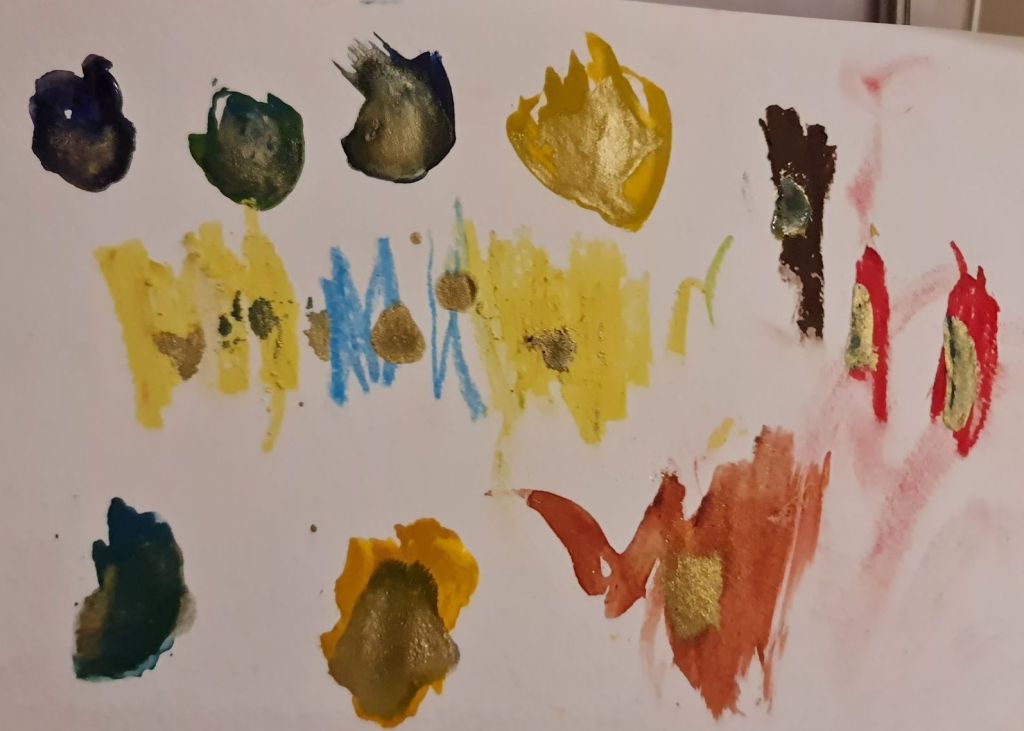
Cinnamon’s painting
Cinnamon’s painting — a child’s vision using those same colours and symbols — becomes the heart of the poem’s moral. Where adults teach flags as abstractions of loyalty, a child paints them as shapes of feeling: colour without propaganda, form without coercion.
Her work reclaims the right to look — to re-see — before the meanings are imposed. In the context of the poem, Cinnamon’s act of painting the flag is the antidote to the refrain “Taught without meaning.” Where the system teaches forgetting, the child reimagines. Where history flattens complexity, the child restores ambiguity and empathy.
Cinnamon’s use of green, white, and red echoes the idea of life, balance, and courage — but stripped of state ideology. In her painting, those colours are no longer a regimented banner; they are living pigments, a field of imagination. If the poem mourns the loss of meaning, her art rebuilds it — intuitively, freely, outside the grammar of indoctrination.
4. The central paradox
The poem does not glorify violence or rebellion. It asks: Why are the violent acts of states celebrated, while the rebels who challenged them are vilified or sanitized? By naming dates, it situates each act of suppression in time, then asks how time itself was manipulated to make those acts appear inevitable, righteous, or distant.
The final refrain —
Taught without meaning, again and again — Until we teach what freedom meant then. — offers a simple ethical task: not to erase flags, but to explain them truthfully; not to reject symbols, but to ensure children know whose voices were silenced behind them.
5. In Cinnamon’s name
Cinnamon’s presence in this work — as daughter, painter, learner — gives the poem its emotional grounding. It is written not to turn her against her peers or teachers, but to give her the language of awareness: that every story has another side, every celebration has a cost, and every colour on a flag once belonged to someone’s body, someone’s field, someone’s dream.
Where the system teaches uniformity, Cinnamon’s act of questioning restores the oldest human right — to see clearly, and to choose what the colours mean.
The sound comes first — a breath through stone, low and slow, as if the earth itself is remembering how to inhale. Then a child.
He’s running uphill through dust the color of rusted gold. His feet slap against the packed clay; the air shivers with heat. Olive trees lean toward him, their silver leaves flickering like the edges of a dream. I can smell the forge — copper and sweat, charcoal and rainwater.
Someone calls his name — Larthu — and he turns, laughing. He can’t be more than twelve. His hands are black with soot, his hair wild. Behind him, the walls of Velathri rise in terraces, roofs glowing red in the late light.
He’s carrying something small, bright: a mirror, newly cast. He stops to watch the sun in it, and for a heartbeat the reflection blinds me — sky above, sky below. He blinks, and both disappear.
I can hear his mother’s voice. She’s kneeling in a courtyard, gutting a lamb for augury, the smoke blue, the air wet with life. Her words move like a song half-forgotten:
“We listen to what the ground doesn’t say.”
The same words my mother once said to me. The echo folds across two thousand years and lands exactly where my pulse is.
The boy looks up — straight at me. He shouldn’t be able to see me, but he does. The pupils widen; the forge-light catches in his eyes.
“Who are you?” I try to ask, but my voice doesn’t reach him. The air between us turns liquid, trembling, and suddenly his mouth is moving, speaking—
mi Larth Velthurna, clan Velθa. ati thu mi cutha, methlum Rasna. thesan thui, aisar ameθ.
śuthinaś cel, zilath mi avil, tinscvil larθas.
acil θuna, θuric sleθ. avilsuś alpan, thui mi.
I am Larth of Velathri, born of the house of Veltha. My mother shows me the secret places, land of the Etruscans. The dawn is here, the gods remain.
In the tomb’s shadow, I grow one year, child of Tin’s breath.
Take me, carry the word. Through years I will rise, through you.
The syllables vibrate through her like thunder underwater. Elara’s mouth moves, repeating them without understanding. Each sound tastes of iron, ash, honey. The vision tilts — walls collapsing into red light — and then the child is gone, only the echo of his name burning behind her teeth:
It’s ridiculous how quickly mud can feel intimate. You spend days fighting it, then one touch and you’re holding a secret.
I brushed the surface with my fingertips. Something solid, smooth beneath the grit. I switched to the trowel, careful, coaxing the layer back grain by grain. The rain had made the clay soft as skin; it peeled away in ribbons.
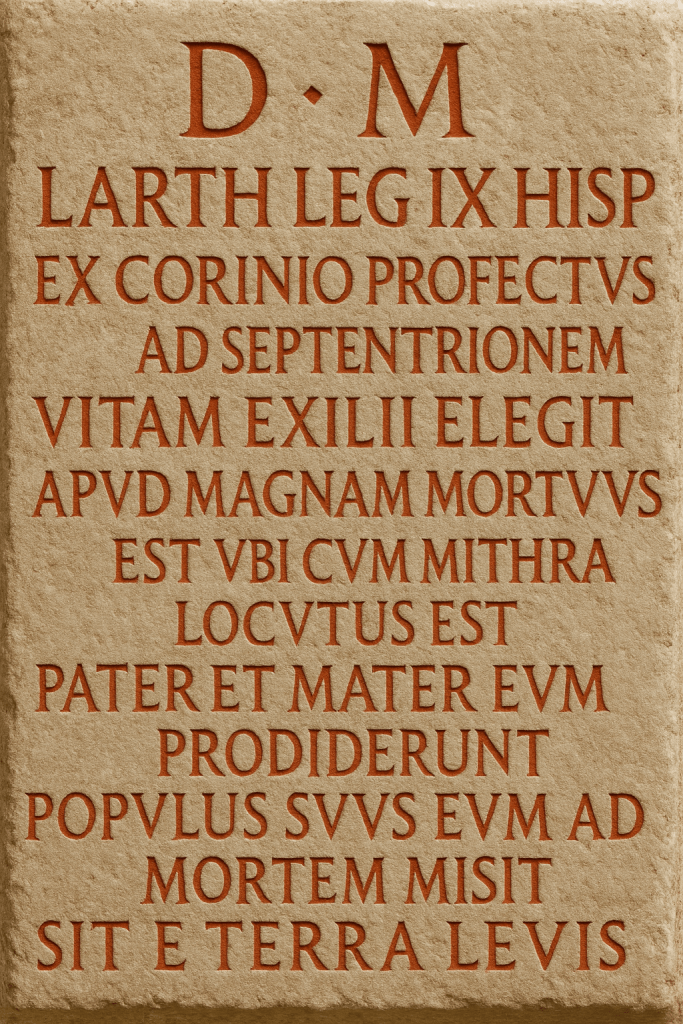
A curve. Then an angle. Then— a letter.
D.
I sat back on my heels, breath fogging the beam of my head-torch. The line was deep, hand-cut, no tool chatter. Another scrape, another letter.
M.
D M. Dis Manibus. The formula for the dead.
I should’ve called the team, logged the context, taken a photograph. Instead I kept brushing. It felt wrong to stop. Like pausing mid-heartbeat.
The red pigment emerged next, faint but definite. Not paint—iron oxide, maybe cinnabar. Old blood color. Whoever carved this wanted it to bleed.
More words surfaced in sequence, as if the earth were exhaling them:
LARTH LEG IX HISP.
I whispered it aloud, the way you test a language against your own mouth. It tasted metallic.
The beam of my torch wavered; the generator groaned. The letters seemed to drink the light. They weren’t just inscribed—they were cut through. Channels, not lines.
I traced one with my glove and felt warmth. Not body heat—something older, stored, like the memory of sunlight in stone.
For a second, everything went still. No wind. No generator. No me.
Then sound came back in pieces: the flap of canvas, a drop hitting water, the low electric hum that shouldn’t have been there.
I crouched closer, my breath syncing to the vibration. It felt… rhythmic. Almost human.
I pressed my palm flat on the inscription.
The world pivoted.
The light from my torch stretched thin, bending toward the ground. A pressure rose through my arm—slow, deliberate, like something recognizing its own name being spoken after a very long time.
In my head, or maybe in the soil, a voice moved— not words yet, just the outline of a word.
Velathri.
I knew it wasn’t Latin. I didn’t know how I knew.
My palm stung. I pulled it back, and the hum stopped. Silence folded in, heavy as water.
I stared at the letters until they blurred. Rain started again, soft, unhurried.
I whispered, “I hear you.”
The wind carried the words away, and somewhere beneath me, the wall breathed back.
The rain stopped just after nine. You could hear the last drops falling off the scaffold poles — that metallic ping that sounds like time counting itself down.
The generator was still running outside, the tent canvas moving with each breath of wind. The smell of damp nylon and instant noodles, wet wool, wet everything.
I was supposed to be cataloguing finds — a few bits of coarseware, two nails, the base of a glass unguent bottle — but my notes had turned to mud along the edges, and my handwriting looked like someone else’s.
Everyone else was asleep or pretending to be. We’d all promised to meet early for core sampling, but promises at digs are weather-dependent.
I poured a little whisky into my enamel mug. Not much, just enough to warm my throat. For a moment, I thought about calling my father — it was his birthday — but the signal up here dies after dark, as if the land itself decides when it’s done speaking.
I opened my laptop anyway. The cursor blinked in an empty document titled Magna Field Notes – Day 19. I stared at it until the generator coughed and the light dimmed.
Day 19. We uncovered nothing new. The wall holds its tongue.
I typed that and stopped.
Outside, the wind shifted, carrying that strange mineral smell again — the one that clings to soil disturbed for the first time in centuries. It’s not unpleasant, just raw. Iron, clay, and something faintly electric.
I shut the laptop, pulled my boots back on, and stepped outside.
The sky was clearing, thin stars behind a scrim of cloud. The trench lamps glowed sodium-yellow against the black mud, a small fortress of light on the edge of an endless moor.
I walked down to the excavation edge. My breath came in steam. The generator’s hum sank into the ground, blending with something lower, older — the sub-bass of water under stone.
Maybe that’s all history is: a kind of sound trapped in matter, waiting for the right frequency to shake it loose.
I crouched by the trench again. Ran my glove along the compacted soil, feeling the fine grit, the cold pulse of buried air. I don’t know why I did it — maybe habit, maybe longing — but I said quietly, “Alright, then. Speak.”
It wasn’t defiance. It wasn’t belief. Just a sentence spoken into fog.
The wind answered first, moving through the plastic sheeting like breath under cloth. Then the low hum again, almost polite.
I waited. Nothing.
But as I turned to leave, the ground gave a little under my heel — a shallow depression, maybe from last week’s rain. The light caught a faint curve beneath the mud, too regular to be stone.
Not the cinematic kind — the dull northern kind that seeps through everything, soft, unending, democratic. By the third week of the Magna excavation, I stopped noticing when I was wet. Mud had become another layer of skin.
The trench kept collapsing. The generator kept choking. The grant was already half-spent and the university wanted results by Christmas — “deliverables,” they called them, as if the earth owed us neat packages of antiquity.
I’d been at this long enough to know that most of archaeology isn’t discovery. It’s negotiation: with weather, with budgets, with the slow indifference of time. Sometimes I think the past resists us — not out of malice, but out of exhaustion.
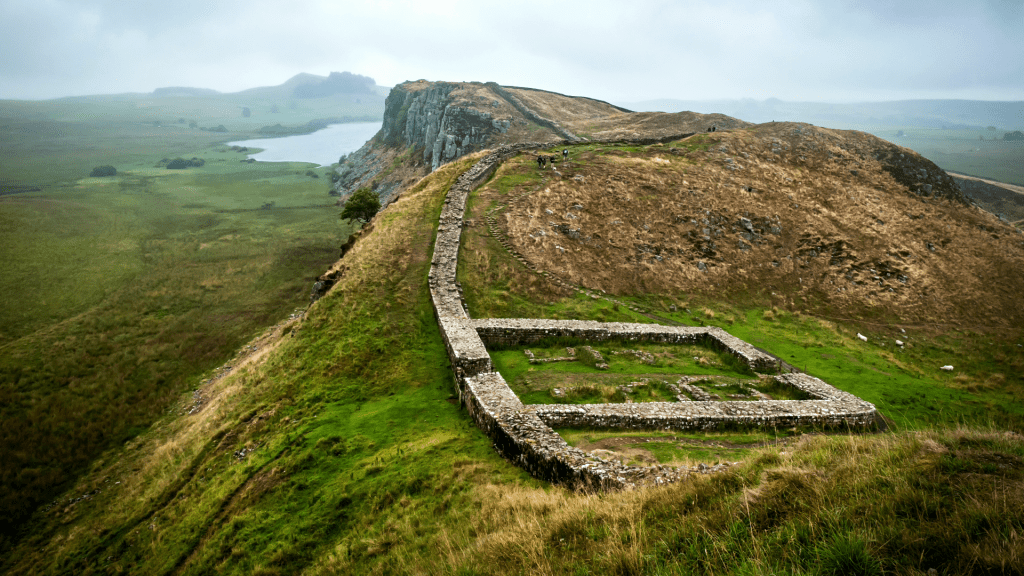
My team had gone back to the prefab lab to upload soil data, so it was just me, a trowel, and a slab of Northumbrian silence. The kind of silence that hums if you listen too long. You could hear the sheep on the next ridge. A crow somewhere. The low pulse of wind turbines to the west.
The ground smelled like iron and salt. The peat was darker here — thicker — as if something once burned under it and never stopped smoldering.
I knelt by the trench, scraping at a stubborn patch of clay, and thought about my mother. I always do, though I don’t call it that. It’s more like a rhythm under thought — her voice reading Latin aloud while I draw liver shapes on butcher paper. Volterra, summer light through dust, the tang of copper tools. She would say, “We listen to what the ground doesn’t say.”
That was before the collapse. Before I stopped listening.
The rain hit harder, drumming against my hood. I checked the time — 17:48. The sky already bruising toward night. The trench lights flickered once and steadied.
I wanted to go home — but home is a word that’s lost its coordinates. Durham feels borrowed, my father’s house hollow, my old flat in Rome long gone. Everywhere I stand is a site. Everything I touch is temporary.
I took another slow pass with the trowel and found nothing. No sherd, no coin, no context. Just the earth returning to itself.
For a moment I let myself imagine: if the Wall could speak, what would it say? The thought was ridiculous, sentimental even. But it stayed. Something beneath me — not a voice exactly, more like pressure, waiting.
I told myself it was fatigue. Fatigue is the archaeologist’s constant god.
I stood, wiped my gloves against my trousers, and looked north. The mist was lifting. The outline of the old Mithraeum loomed just beyond the safety barrier — half exposed, half asleep.
That’s when I thought I heard it — a low hum through the ground, like a current running under my boots. Then a heartbeat of stillness.
I crouched again. Pressed my palm flat into the mud. The warmth startled me — not body heat, something deeper.
It was probably the generator. It was probably nothing.
I didn’t know yet that I’d just touched the edge of a name.
Larth clan śuthina, thesan θu mi avil. Tin θanur, Mithra alpan. θuśθas amce, zilach mi avil, fler rasnal ameθ.
Larth lies in the earth, the dawn took my years. Tin watches, Mithras receives. From silence he speaks, I served my years, blood of the Etruscans endures.




 Space Epics - Stories from the Multi-Verse