Follow-down by Cedar River Editor
In Book IV, Asynonymous guides the reader into a night of murmuring pine and low electrical hum—a threshold where history, fever, and remembrance fuse. The work unfolds as a polyphonic ritual, an epic that remembers empire and illness alike as states of the body, speaking in the tongues of the living and the dead.
Across Asynonymous’s recent creations, three rivers converge. The first is the meditation on Roman impermanence: from Hadrian’s tempered authority to Marcus Aurelius’s weary piety, from the defiant DE GERM trophy to Gordian’s fragile SECVRITAS PVBLICA. The second river is the voice of Georg Christiansen, writing from Aarhus in 1943—a man who, like the emperors, faced dissolution but answered with quiet lucidity. The third is a widening current of ritual language, where Latin, Japanese, Greek, and reconstructed Etruscan meet not to fuse but to resonate. Book IV is where these waters braid.
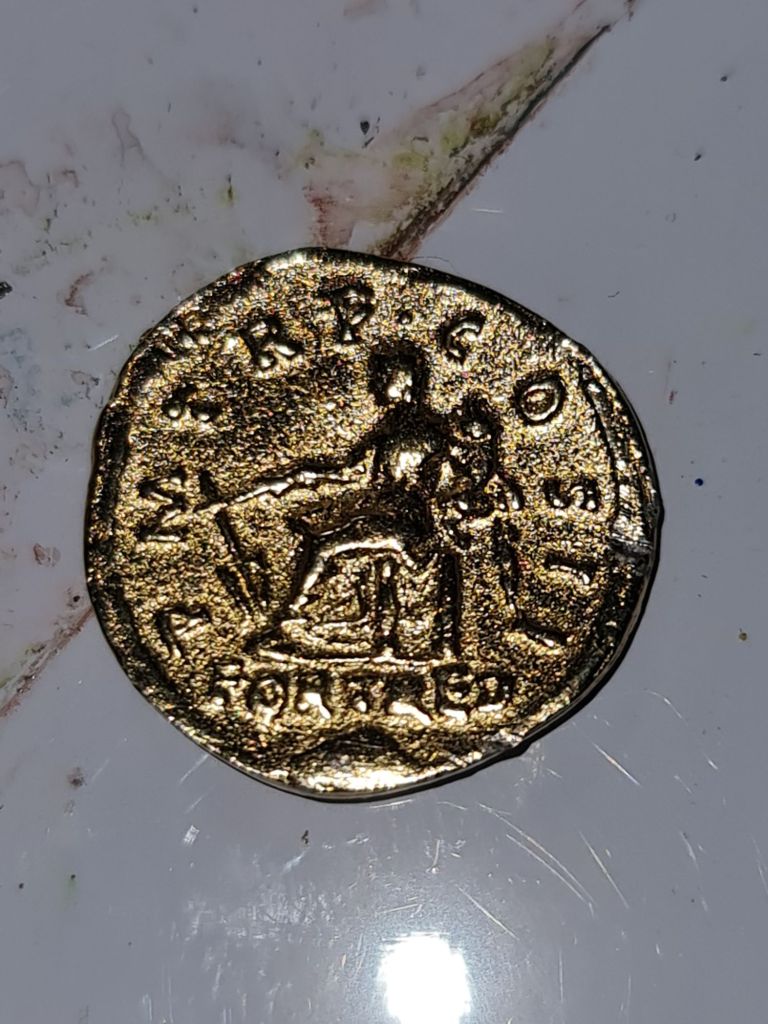
Each Roman coin becomes a temporal seed. The aureus of Marcus Aurelius bears FORT RED—Fortuna Redux, fortune returned. In Asynonymous’s verse, that omen transforms: mens sola redit—the mind alone returns. History is read not as conquest but as the anatomy of return, the act of bringing oneself home from ruin. The poem’s architecture—liturgical chant, stage direction, mythic echo—rebuilds that home in sound.
The cast of voices—the Match Girl, the Soviet babushka, Cthulhu, Jung, Momo, the Happy Prince—inhabit a global liturgy of empathy. Their refrain, “No demons, only hands,” stands as the central ethics of the work. It is both exorcism and recognition. Evil here is not metaphysical; it is enacted. Salvation, likewise, is made by hands—hands that strike matches, hands that heal, hands that remember.
The multilingual prayers deepen this ethic. The Latin plea “Magister Terrarum Magnus, vulnera nostra amplectere” meets the Shintō invocation of Ōkuninushi and the Etruscan murmur “śanś tenθur śec.” Together they form a ritual chorus that seeks not transcendence but integration—a healing in silence. Asynonymous frames language itself as DNA, with the four letters—A, T, C, G—becoming vows of creation, divinity, and embrace. The genome becomes liturgy; the poem becomes the body remembering itself.
Geographically, the work maps the same diagonal line traced in the author’s map—Ho Chi Minh City to Council Bluffs, Svobodnyy to Goiás. It is the line of cultural drift, the global meridian of modern solitude, and yet every location becomes a beacon, a moment of collective attention. The NeverEnder project positions these readings as living coordinates of resonance: the world listening in different languages to the same silence.
In its later sequences, Book IV enters the realm of mythic diagnosis. The Morgana cycle, the fractured prophecies of Merlin, the rising of the people—all transform trauma into civic dream. Morgana’s deceit is answered not by exorcism but by exhaustion; Merlin’s silence is not defeat but refusal to speak the language of domination. The silence that falls over the land—silentium plenum—is not emptiness but fullness: the moment where a new word germinates in the dark.
The recurring motifs—fever, rust, memory—act as Asynonymous’s triad of redemption. Fever bends time, rust remembers, memory does not heal but witnesses. From the burning of Mesiche to the quiet defiance at Circesium, from Georg’s last letter to the Etruscan prayer for the underworld, Book IV composes a single gesture of attention: to stay, to see, to sing.
At its close, the myth of Mithras breaks through illusion: lux per simulationem ardet—the light burns through illusion. The empire trembles, but the path continues. The poem ends not with triumph but with community: voices, hands, silence.
If earlier volumes descended into the labyrinth, Book IV marks the turn within it—the moment of recognition that return is not escape but continuation. The empire, the body, and the memory all fracture, yet from that fracture a liturgical ethic emerges:
Esse quam videri. To be, not to seem.
What remains is not doctrine, nor even hope, but practice.
Hands.
Not demons.
Hands that write, light, heal, and carry the ember forward.
Hands that keep company in the dark.
— Cedar River Editor
 Space Epics - Stories from the Multi-Verse