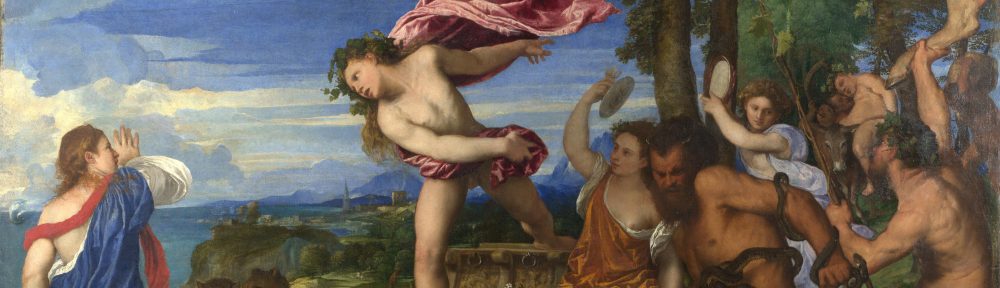
(Milano, 1884 – The Hanged Man Dream)
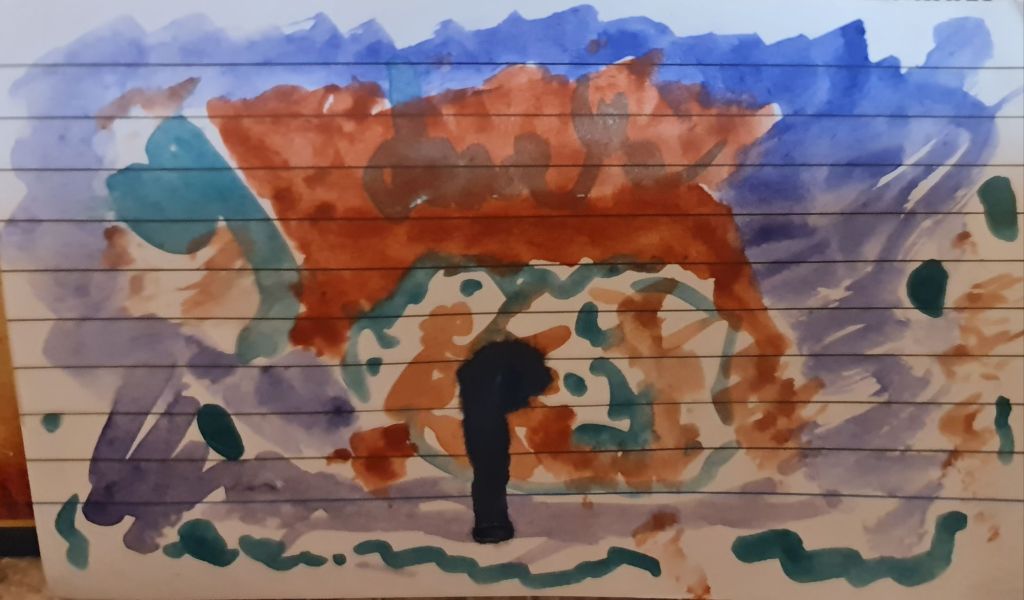
From the crystal cave he misspoke, inverted in time,
his silver hair a net of spider light.
Mithras had risen, and Merlin hung between breaths —
one eye fixed upon shadow,
the other upon the hand of a child
scribbling suns upon the void.
On the horizon lay the book:
Della Schiavitù Moderna,
its cover pale as bone,
its date an omen — Milano, 1884.
There, in a thin script of righteous grief,
a man had written of chains made holy,
of souls bound by mercy’s own design.
Merlin turned the corner.
The ink flamed.
Words became iron.
Iron became mirrors.
Mirrors became the faces of the living —
and he hailed her,
the young silver dragon,
drawing circles of rebellion
in yellow, blue, and red.
Each mark defied empire.
Each line whispered: I am not yours.
Where reason would have written laws,
she made light instead —
a grammar of breath and movement,
a syntax of sky.
And in the hush between penstrokes,
a song rose from the dust:
> Constant craving,
you have been to the darkest phase,
maybe we have met before.
The philosopher’s eyes opened.
He remembered.
Chains of thought.
Crowns of virtue.
The sweetness of control.
He had written it all, once —
in another life,
when he believed anger was salvation.
Now, the child’s hand slapped him,
and in that slap,
he was touched.
The Hanged Man lay still
and the tides reversed.
Ink ran backward into silence.
Freedom, at last, was shot in colour.
 Space Epics - Stories from the Multi-Verse