
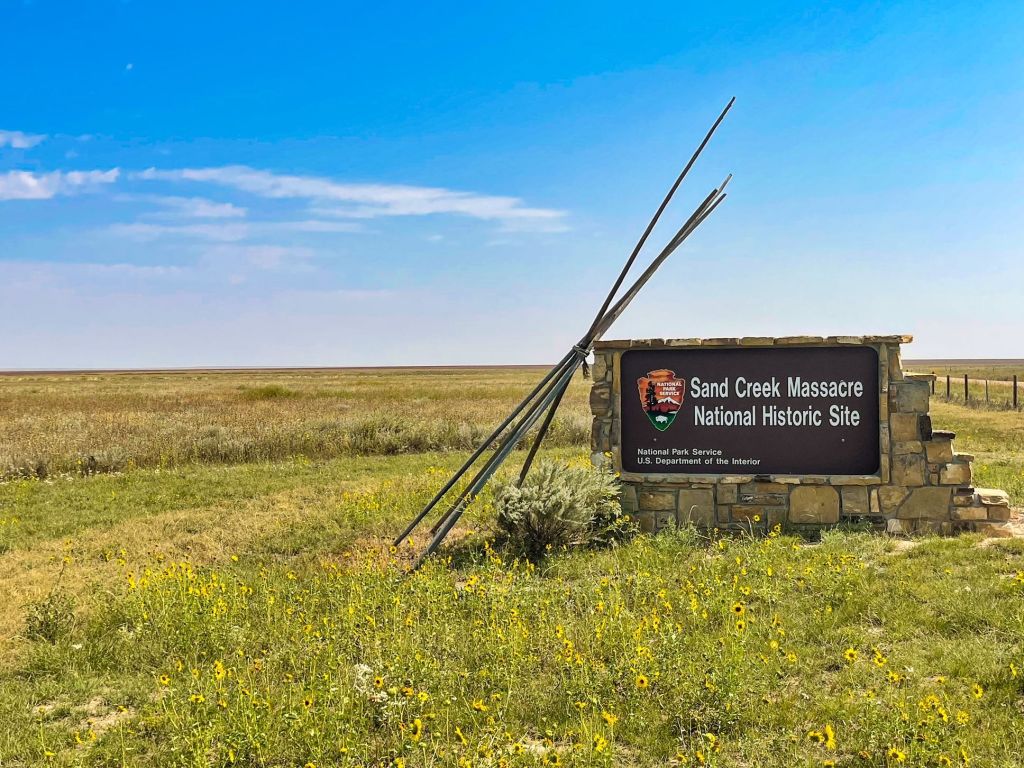
38°32′58″N 102°30′41″W
Composed out of time
Preface
My dear friend,—
I have learned that the world does not merely contain beauty; it contains graves upon which beauty still insists on blooming. I write to you from such a place. If I have any authority to speak, it is the authority of one who has failed often and suffered some, and who has discovered that suffering, when it is accepted, makes the earth itself articulate. What follows is not history—others have accounted dates and numbers with more precision than I could pretend—but a confession set down in the cadence of the plains, and addressed to the living through the testimony of the dead.
I — Upon the Dry Creek, Where the Wind Remembers
It is one of the cruelties of this vast Republic that its plains can hold beauty enough to quiet the heart, and yet bear upon their soil the indelible impress of an unpardonable deed. To travel east from the Front Range is to enter a world so wide that the horizon retreats like a patient animal avoiding the reaching hand. Here the sun rests with too much intimacy, and the wind whispers in voices both ancient and accusatory. They tell, though not to every ear, the story of Sand Creek.
On the morning of November the twenty-ninth, eighteen hundred and sixty-four, Colonel Chivington and his men, riding not in defence but in premeditation, descended upon a sleeping village of Cheyenne and Arapaho—seven hundred souls, most unarmed, trusting the pale light of dawn to deliver them to the safety of another day. They were wrong. The hour brought not the blessing of survival but a storm of musket and howitzer, whose music was the tearing of flesh and the breaking of peace.
Women, children, the old—the ones civilisation professes to cherish—fled into the dry bed of the creek, digging at the earth as though the soil might become their mother again and spare them the sight of what men will do when they believe the land itself conspires with them. For seven hours the air thickened with smoke and unmeasured grief. Thirteen Cheyenne peace chiefs fell there, and one Arapaho chief—pillars of a governance not of ballots and treaties, but of inherited trust. And as if murder were not sufficient, the afternoon and the following day were given to desecration: trophies taken from the dead, gestures both cowardly and vainglorious. On December the first, the soldiers rode away with six hundred captured horses and left behind a silence that was not peace, but the stunned immobility of a world uncertain whether to continue at all.
The roots of such a deed were tangled across the continent—the Civil War’s licence, the settlers’ vengeance after Minnesota, the governor’s ambition, the benedictions of the pious upon the cannon’s mouth. Beneath all, as the river beneath ice, moved that fixed conviction—Manifest Destiny: the creed that to take is a right and to kill an unfortunate instrument in the taking. And yet the plains remember. The Sand Creek Massacre National Historic Site preserves not a point on a map but a wound in the earth’s own body, that its scar might speak across the years: to protect this landscape and interpret its sorrow, so the future might be less credulous of its own innocence.
For where there is suffering, there is sacred ground; and here, the ground remembers.
II — A Letter Written in Dust
I write these lines not as a historian, for the historian enjoys the comfort of distance, nor as a patriot, for patriotism is the most polished instrument by which such wrongs are committed, but as one whose shoes have stirred the same dust in which the dead of Sand Creek were laid. It is a strange fate to travel for beauty and to find, in every beautiful place, the tomb of a forgotten crime.
America, when first I met her, wore the bright raiment of the future—stations like temples of industry, cities with the swagger of youth, a theatre in every metropolis, a flag in every wind. Yet beside me at the banquet there sat a shadow with the breath of graves. I did not name it then; I preferred to believe a nation could be built upon liberty while ignoring the skeletons in its foundations. Such self-deception is a luxury purchased at the expense of other people’s lives.
Sand Creek is not merely the scene of a massacre; it is a mirror in which the face of civilisation is seen without its cosmetics. In that mirror I find my own reflection—not holding a rifle, but holding silence. And silence, when it is willed, is complicity. I did not ride with Chivington’s men; I rode instead in carriages along boulevards built over bones, dined in houses furnished by lands stripped bare, and thought only of the flavour of the wine. The newspapers of that year—oh, the newspapers!—spoke of “pacification” and “necessary measures,” as now they speak of “progress.” Language is the mask with which power conceals the bruise on its knuckles.
So I walk the ridges of Sand Creek not as a tourist but as a penitent. The wind does not gossip idly; it asks whether I will carry with me merely the weight of knowledge or the heavier, more transforming weight of guilt. I would wish to be free of both, and yet the second is the only honest inheritance of one who has stood upon this soil.
In prison I learned that the walls we build to confine others will, in time, enclose ourselves. So too with nations. The frontier’s forts decay, but the fortress of myth remains. To dismantle it is the work not of armies but of confession, and confession is the art for which men have the least appetite.
The ground has already spoken, and it says: you will remember me, or you will become me.
III — The Testament of the Plains
History leaves no fresh flowers upon its graves; the task is left to those who come after. Yet I have seen that when the descendants of the murdered stand upon this soil, the wind moves differently, as though the air itself recognises the shape of their sorrow. This is the truest function of a memorial—not that the living teach the dead their importance, but that the dead remind the living of their obligations.
I am told the site is preserved by law; visitors walk with careful step; signs interpret the day’s obscenity with the courtesy of curated language. These are good things, yet they are but the frame. What I fear is the domestication of horror—that Sand Creek might be absorbed into the polite museum of the national conscience, where it may be admired without being confronted.
For what would it profit us to remember the shapes of the fallen if we do not change the shape of the living? The tribes lost more than leaders that day; they lost the unbroken thread of governance woven through generations. A people’s way of being was torn, and the ripples of that tear move still through their descendants’ lives.
I set down these pages not as tribute—tribute is empire’s coin—but as debt: not to the dead, who are beyond all debts, but to those who live with their absence. I have no power to make amends; I have only the power to refuse amnesia. That, in the end, is all any of us can promise.
If the future asks what I learned here, I will say: that where there is suffering there is sacred ground; that no wind is ever truly empty; that the plains keep their own counsel, yet speak to those who arrive without the armour of innocence. And I will say that a nation’s greatness is not measured by the height of its buildings or the reach of its armies, but by the depth of its memory.
Forgetting is the most fashionable crime of our age. Let this dry creek, where the wind remembers, be the unanswerable witness—the stone in the shoe of progress, the shadow across the banquet, the uninvited guest who will not be dismissed. And let it be, above all, a promise: that no similar dawn shall ever again break upon a camp unarmed and at peace while men who call themselves soldiers make war upon the sleeping.
—
Yours, in the difficult charity of remembrance.
 Space Epics - Stories from the Multi-Verse